
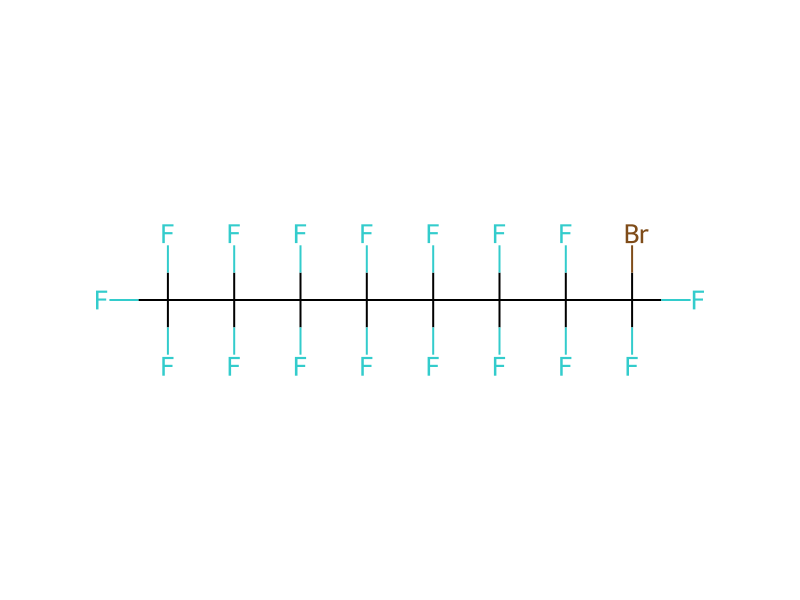
Basic information
- Standard SMILES
FC(F)(F)C(F)(F)C(F)(F)C(F)(F)C(F)(F)C(F)(F)C(F)(F)C(F)(F)Br- InChIKey
WTWWXOGTJWMJHI-UHFFFAOYSA-N- Molecular formula
- C8BrF17
- Average molar mass
- 498.96 g/mol
- Monoisotopic mass
- 497.89119
Names & identifiers
- Preferred name
- Perfluorooctyl bromide
- IUPAC
- 1-bromo-1,1,2,2,3,3,4,4,5,5,6,6,7,7,8,8,8-heptadecafluorooctane
- English name
- 1-BroMoheptadecafluorooctane
- Molecular formula
- C8BrF17
- Molecular weight
- 498.96
Names & synonyms
Perflubron423-55-21-BromoperfluorooctanePerfluorooctyl bromide1-BromoheptadecafluorooctanePerfluoroctyl bromide1-bromo-1,1,2,2,3,3,4,4,5,5,6,6,7,7,8,8,8-heptadecafluorooctanePerfluorooctylbromidePFOBN-perfluorooctyl bromideperfluorocaprylyl bromideDTXSID5046560
Show more names
ImagentHEPTADECAFLUORO-N-OCTYL BROMIDETBr-8uorooctanelong’scompound
OCTANE, 1-BROMOHEPTADECAFLUORO-Q1D0Q7R4D9Octane, 1-bromo-1,1,2,2,3,3,4,4,5,5,6,6,7,7,8,8,8-heptadecafluoro-DTXCID3026560CHEBI:38803perfluoroctylbromideperflubronumperfluorooctyliodide
Database identifiers
- CAS
423-55-2- PubChem CID
- 9873
- DTXSID
DTXSID5046560- ChEMBL
CHEMBL1200866- ChEBI
CHEBI:38803- UNII
- Q1D0Q7R4D9
- EC Number
- 207-028-4
- Nikkaji
- J94.754G
Properties
Computed structural properties
- XLogP
- 6.9
- Topological polar surface area
- 0 Ų
- Hydrogen bond donors
- 0
- Hydrogen bond acceptors
- 17
- Rotatable bonds
- 6
- Heavy atoms
- 26
- Formal charge
- 0
- Complexity
- 527
Experimental & physicochemical properties
Kovats Retention Index581
Physicochemical properties
- Melting point
- 6 °C · 6 °C
- Boiling point
- 142 °C · 142 °C(lit.)
- Density
- 1.93 g/mL · 1.93 g/mL at 25 °C(lit.)
- vapor pressure
- 12.8 · 12.8-72hPa at 25-65℃
- refractive index
- 20 · n20/D 1.305(lit.)
- Flash point
- 141 · 141-143°C
- storage temp.
- Sealed in dry,Room Temperature
- solubility
- Soluble in DMSO
- form
- Viscous Solution
- Specific Gravity
- 1.93 · 1.930
- color
- Colorless to tan
- Water Solubility
- Not miscible or difficult to mix in water.
- Merck
- 14 · 14,7156
- BRN
- 2016022 · 2016022
- Cosmetics Ingredients Functions
- SOLVENT
- InChI
- 1S/C8BrF17/c9-7(22,23)5(18,19)3(14,15)1(10,11)2(12,13)4(16,17)6(20,21)8(24,25)26
- InChIKey
- WTWWXOGTJWMJHI-UHFFFAOYSA-N
- SMILES
- FC(F)(F)C(F)(F)C(F)(F)C(F)(F)C(F)(F)C(F)(F)C(F)(F)C(F)(F)Br
- LogP
- 6.1 at · 6.1 at 25℃
- CAS DataBase Reference
- 423 · 423-55-2(CAS DataBase Reference)
- EWG's Food Scores
- 1 · 1
- FDA UNII
- 1 D0Q7R4D9 · Q1D0Q7R4D9
- NCI Drug Dictionary
- Imagent
- ATC code
- 8 CX01 · V08CX01
- EPA Substance Registry System
- 1 · 1-Bromoheptadecafluorooctane (423-55-2)
- UNSPSC Code
- 41116107 · 41116107
- NACRES
- 24 · NA.24
- Symbol(GHS)
- 7 · GHS07
- Signal word
- Warning
- Hazard statements
- 315 · H315-H319-H335
- Precautionary statements
- 305 · P305+P351+P338
- target organs
- Respiratory system
- PPE
- Eyeshields, Gloves, type ABEK (EN14387) respirator filter
- Hazard Codes
- Xi
- Risk Statements
- 36 · 36/37/38
- Safety Statements
- 26 · 26-37/39
- RIDADR
- 2810 · 2810
- WGK Germany
- 3 · 3
- RTECS
- 8700000 · RG8700000
- Hazard Note
- Irritant
- HazardClass
- 6.1 · 6.1(b)
- PackingGroup
- III
- HS Code
- 29037800 · 29037800
- Storage Class
- 10 · 10 - Combustible liquids
- Hazard Classifications
- 2 Skin · Eye Irrit. 2Skin Irrit. 2STOT SE 3
- Toxicity
- 50 i.v · LD50 i.v. in female rats: 41 g/kg (Burgan)
- REACH Registrations
- Active
Safety & regulation
GHS classification
GHS Classification
Warning
H315 (90.9%): Causes skin irritation [Warning Skin corrosion/irritation];H319 (90.9%): Causes serious eye irritation [Warning Serious eye damage/eye irritation];H335 (89.1%): May cause respiratory irritation [Warning Specific target organ toxicity, single exposure; Respiratory tract irritation]
P261, P264, P264+P265, P271, P280, P302+P352, P304+P340, P305+P351+P338, P319, P321, P332+P317, P337+P317, P362+P364, P403+P233, P405, and P501 (click each P-code to see the statement)
Aggregated GHS information provided per 55 reports by companies from 9 notifications to the ECHA C&L Inventory. Each notification may be associated with multiple companies.;Information may vary between notifications depending on impurities, additives, and other factors. The percentage value in parenthesis indicates the notified classification ratio from companies that provide hazard codes. Only hazard codes with percentage values above 10% are shown. For more detailed information, please visit ECHA C&L website.
H413: May cause long lasting harmful effects to aquatic life [Hazardous to the aquatic environment, long-term hazard]
Hazard information
Regulatory InformationStatus: Active Update: 22-10-2018 https://echa.europa.eu/registration-dossier/-/registered-dossier/23055
Hazard Classes and Categories
Skin Irrit. 2 (90.9%);Eye Irrit. 2 (90.9%);STOT SE 3 (89.1%)
Hazardous to the aquatic environment (Long-term) - Category 4
Regulatory information
Regulatory InformationStatus: Active Update: 22-10-2018 https://echa.europa.eu/registration-dossier/-/registered-dossier/23055
Safety data
- PPE
- Eyeshields, Gloves, type ABEK (EN14387) respirator filter
- wgk
- 3
- rtecs
- RG8700000
- ridadr
- 2810
- hs_code
- 29037800
- Toxicity
- LD50 i.v. in female rats: 41 g/kg (Burgan)
- risk_code
- 36/37/38
- Signal word
- Warning
- Symbol(GHS)
- GHS07
- hazard_code
- Xi
- hazard_note
- Irritant
- safety_code
- 26-37/39
- hazard_class
- 6.1(b)
- Storage Class
- 10 - Combustible liquids
- packing_group
- III
- target organs
- Respiratory system
- Hazard statements
- H315-H319-H335
- REACH Registrations
- Active
- Hazard Classifications
- Eye Irrit. 2Skin Irrit. 2STOT SE 3
- Precautionary statements
- P305+P351+P338
Chemistry & industry
Pharmacology
ATC Code
V - Various;V08 - Contrast media;V08C - Magnetic resonance imaging contrast media;V08CX - Other magnetic resonance imaging contrast media;V08CX01 - Perflubron
QV - Various;QV08 - Contrast media;QV08C - Magnetic resonance imaging contrast media;QV08CX - Other magnetic resonance imaging contrast media;QV08CX01 - Perflubron
Mechanism of Action
Perflubron emulsion (Oxygent) maintains hemodynamic stability during major surgery, thereby potentially reducing or avoiding intraoperative transfusions of donor blood in major surgery.Perflubron emulsion has ability to enable patients to be physiologically stable and safe at lower intraoperative Hb levels.
MeSH Pharmacological Classification
Substances used to allow enhanced visualization of tissues.
Drugs used to potentiate the effectiveness of radiation therapy in destroying unwanted cells.
Agents that increase energy expenditure and weight loss by neural and metabolic regulation.
Uses & manufacturing
Uses
• Ophthalmology [Ref: https://doi.org/10.1155/2014/250323];• Oxygen carrier for artificial blood [Ref: https://doi.org/10.1039/c7gc03081a];• Solvent for printing ink [Ref: CAS2019 (CN109810567)];• X-ray imaging [Ref: https://doi.org/10.1007/978-1-4899-1202-2];• Supply of gases, including CO2, to microbial cells [Ref: https://doi.org/10.1007/978-1-4899-1202-2]
non-polymer PFAS -> Printing (Inks) -> Toner and printer inks;non-polymer PFAS -> Pharmaceutical Industry -> Processing aid in the manufacture of microporous particles;non-polymer PFAS -> Medicinal Utensils -> Retinal detachment surgery and proliferative vitreoretinopathy;non-polymer PFAS -> Medicinal Utensils -> Supplement conventional blood transfusion and artificial blood and perfusion of isolated organs;non-polymer PFAS -> Medicinal Utensils -> Contrast agent;non-polymer PFAS -> Biotechnology -> Supply of oxygen and other gases to cells in culture
Use ClassificationPFAS (per- and polyfluoroalkyl substances) -> OECD Category
Applications
Uses1-Bromoperfluorooctane 1-Bromoheptadecafluorooctane (perfluorooctyl bromide) can be used as contrast agent in the vascular system for fluorine-19 magnetic resonance imaging or as synthetic oxygen carrier. It is used as an O2 carrier in some emulsions.
Uses1-BroMoheptadecafluorooctane can be used as oxygen carrier in emulsions used as blood substitutes.
General Description1-Bromoheptadecafluorooctane (perfluorooctyl bromide) is a perfluorocarbon. Poly(ethylene glycol)ylated polyester nanocapsules of perfluorooctyl bromide were surface-decorated with a RGD (arginine-glycine-aspartic acid) peptide, were used for tumor imaging. Nanocapsules of perfluorooctyl bromide have been developed as dual contrast agent for ultrasonography and Magnetic Resonance Imaging (MRI).
Upstream & downstream products
Upstream raw materials
Downstream products
Suppliers50 total
国药集团化学试剂有限公司86-21-63210123 · [email protected]
梯希爱(上海)化成工业发展有限公司021-67121386 · [email protected]
上海阿拉丁生化科技股份有限公司400-6206333 13167063860 · [email protected]
江西核研院新材料有限公司18901398682 18901398682 · [email protected]
上海比阳实业有限公司+86-21-52699951; +8613917686115 · [email protected]
河南多贝化工有限公司0370-6999054 17550096163 · [email protected]
上海遐瑞医药科技有限公司+86-021-61551413 · [email protected]
T&W GROUP021-61551611 13296011611 · [email protected]
锦州恒通氟化学有限公司0418-2558700 · [email protected]
上海迈瑞尔生化科技有限公司4006356688 18621169109 · [email protected]
北京华威锐科化工有限公司0757-86329057 18934348241 · [email protected]
阿法埃莎(中国)化学有限公司400-6106006 · [email protected]
安耐吉化学&3A(安徽泽升科技股份有限公司)400-0056266 · [email protected]
武汉凯威斯科技有限公司86-027-67849912 · [email protected]
Allfluoro Pharmaceutical Company Limited+86-400-0216110 +86-15958047586 · [email protected]
上海瀚鸿科技股份有限公司021-54306202 13764082696 · [email protected]
上海钰康生物科技有限公司+86-18930848214 +86-021-56762820 · [email protected]
西氟科技有限公司0531-85906692 15588812394
武汉丰泰威远科技有限公司+86-27-8746-5837 +86-18627785180 · [email protected]
武汉赛沃尔化工有限公司027-85613400 18707177243 · [email protected]
上海比阳实业有限公司+86-15021878111 · [email protected]
武汉丰泰威远科技有限公司027-87465837 19945049750 · [email protected]
上氟科技021-65170832 15601903708 · [email protected]
山东西亚化学有限公司13355009207 13355009207 · [email protected]
天津希恩思生化科技有限公司400 638 7771 · [email protected]
赛默飞世尔科技(中国)有限公司800-810-5118 · [email protected]
北京伊诺凯科技有限公司400-810-7969 010-59572699 · [email protected]
上海特伯化学科技有限公司+86-21-60341587 · [email protected]
江苏艾康生物医药研发有限公司025-66113011 13913916777 · [email protected]
TCI AMERICA800-4238616 · [email protected]
TOKYO CHEMICAL INDUSTRY CO., LTD.03-36680489 · [email protected]
TCI Europe320-37350700 · [email protected]
Clearsynth Labs Limited+91-22-26355700 · [email protected]
苏州中博化工科技有限公司15250602200 · [email protected]
Yangzhou Model Electronic Materials Co., Ltd.+8613761402923 · [email protected]
上海将来实业股份有限公司021-61552785 · [email protected]
湖南华腾制药有限公司400-8592883 · [email protected]
上海麦克林生化科技股份有限公司15221275939 15221275939 · [email protected]
上海有朋化工有限公司021-69005955 13701776567 · [email protected]
上海兴鲁化工科技有限公司02120970332 · [email protected]
湖北巨胜科技有限公司027-59599241 18871490274 · [email protected]
Sigma-Aldrich西格玛奥德里奇(上海)贸易有限公司021-61415566 800-8193336 · [email protected]
江苏倍达医药科技有限公司0512-63009836 18994340901 · [email protected]
TargetMol中国(陶术生物)021-021-33632979 15002134094 · [email protected]
上海陶术生物科技股份有限公司+1-781-999-5354; +1-00000000000 · [email protected]
九鼎化学(上海)科技有限公司4009209199 · [email protected]
君隽未来(江苏)生物医药有限公司13814192480; 13814192480 · [email protected]
浙江泽天精细化工有限公司0571-87322520 18957127338 · [email protected]
上海珞珐生化科技有限公司021-51111890 15317326293 · [email protected]
成都润泽本土化工有限公司028-88469284 18000562381 · [email protected]
Additional notes
DefinitionChEBI: Perflubron is a haloalkane that is perfluorooctane in which a fluorine attached to one of the terminal carbons has been replaced by a bromine. It has a role as a radioopaque medium and a blood substitute. It is a perfluorinated compound, an organobromine compound and a haloalkane. It derives from a hydride of an octane.
Related reactions
8 records







Linked notes
Loading…