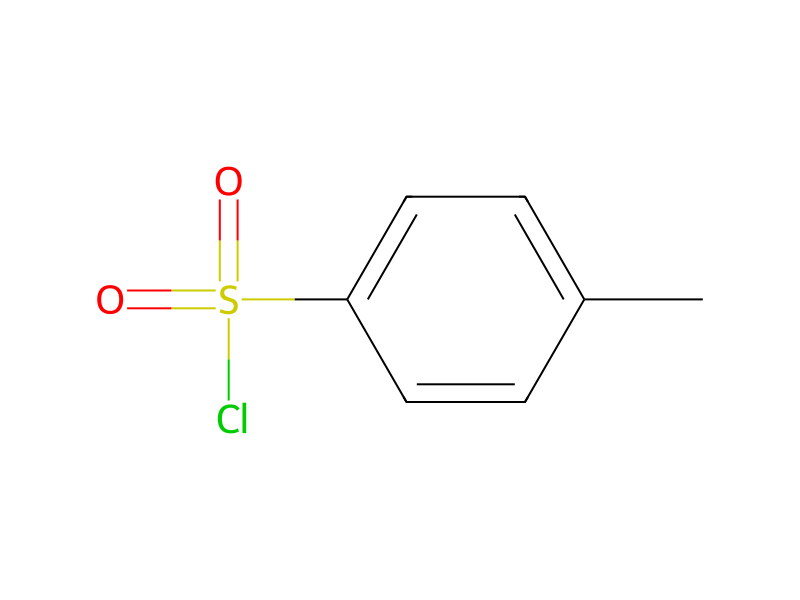
4-Toluenesulfonyl chloride → 2-[2-(p-Toluenesulphonyloxy)ethyl]chroman
HRID 1032413
Reaction equation

[C:1]1([CH3:11])[CH:6]=[CH:5][C:4]([S:7](Cl)(=[O:9])=[O:8])=[CH:3][CH:2]=1.[OH:12][CH2:13][CH2:14][CH:15]1[CH2:24][CH2:23][C:22]2[C:17](=[CH:18][CH:19]=[CH:20][CH:21]=2)[O:16]1>N1C=CC=CC=1>[C:1]1([CH3:11])[CH:6]=[CH:5][C:4]([S:7]([O:12][CH2:13][CH2:14][CH:15]2[CH2:24][CH2:23][C:22]3[C:17](=[CH:18][CH:19]=[CH:20][CH:21]=3)[O:16]2)(=[O:9])=[O:8])=[CH:3][CH:2]=1Participants
4
Reactant 2

Product 1

Reagents, catalysts & solvents 1

Procedure
15.73 g (82.5 mmol) of p-toluenesulphonyl chloride are added at room temperature while stirring to a solution of 13.36 g (75 mmol) of 2-(2-hydroxyethyl)chroman in 90 ml of absolute pyridine, the slightly exothermic reaction being maintained at room temperature by means of an ice bath. After stirring for a further 3 hours at room temperature, the reaction mixture is poured onto ice-water. The crystals formed are filtered off with suction, washed with water and dried in vacuo. There are obtained 8.68 g (34.7%) of 2-[2-(p-toluenesulphonyloxy)ethyl]chroman which melts at 57°-59°.