Reaction equation

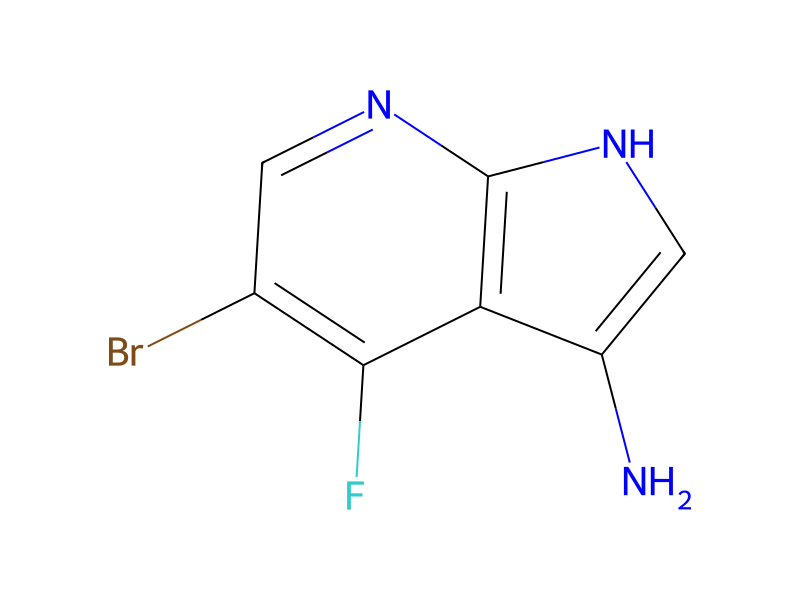
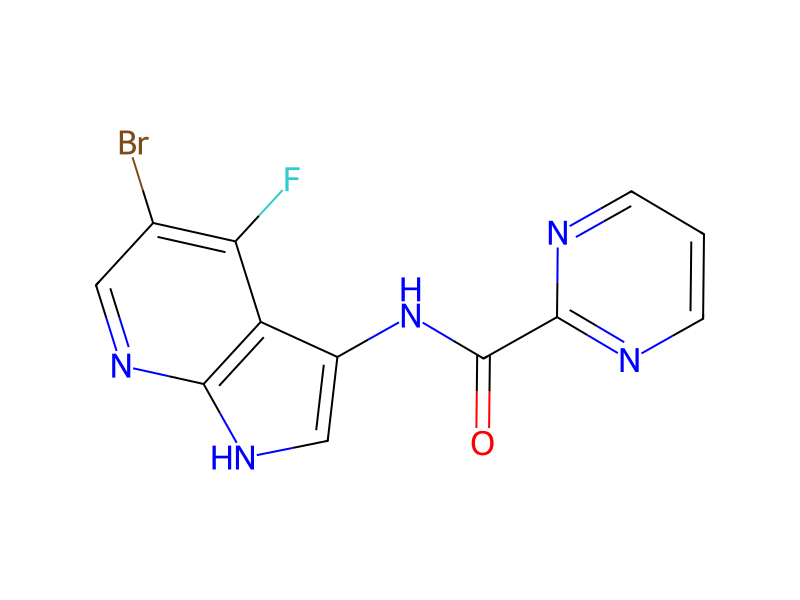
[Br:1][C:2]1[C:3]([F:12])=[C:4]2[C:10]([NH2:11])=[CH:9][NH:8][C:5]2=[N:6][CH:7]=1.[N:13]1[CH:18]=[CH:17][CH:16]=[N:15][C:14]=1[C:19](O)=[O:20].O=C1N(P(Cl)(N2CCOC2=O)=O)CCO1.C(N(CC)CC)C>C(Cl)Cl.O>[Br:1][C:2]1[C:3]([F:12])=[C:4]2[C:10]([NH:11][C:19]([C:14]3[N:15]=[CH:16][CH:17]=[CH:18][N:13]=3)=[O:20])=[CH:9][NH:8][C:5]2=[N:6][CH:7]=1Participants
Reactant 4



Product 1
Reagents, catalysts & solvents 2


Procedure
A solution of 5-bromo-4-fluoro-1H-pyrrolo[2,3-b]pyridin-3-amine (200 mg, 0.869 mmol, Example 1, Step H) in CH2Cl2 (10 mL) was treated with pyrimidine-2-carboxylic acid (129 mg, 1.04 mmol), bis(2-oxooxazolidin-3-yl)phosphinic chloride (332 mg, 1.30 mmol) and triethylamine (440 mg, 4.35 mmol). The reaction was stirred at room temperature for 48 hour, and then water (10 mL) was added. The reaction was stirred for 1 hour. The solid which separated was filtered and washed with CH2Cl2 (10 mL). The filtered cake was dried to yield N-(5-bromo-4-fluoro-1H-pyrrolo[2,3-b]pyridin-3-yl)pyrimidine-2-carboxamide (110 mg, 38% yield). 1H NMR (400 MHz, (CD3)2SO) δ 12.21 (br s, 1H), 10.47 (s, 1H), 9.06 (d, 2H), 8.40 (d, 1H), 7.87 (d, 1H), 7.77 (t, 1H); LCMS (APCI+) m/z 335.9, 337.9 (M+H)+, Retention time=2.70 minutes (Method 2).
Workup
- stirringThe reaction was stirred for 1 hour
- customThe solid which separated
- filtrationwas filtered
- washwashed with CH2Cl2 (10 mL)
- customThe filtered cake was dried
Sources & evidence
- ORD record
- ord-c974a4d0584440b7a38b46e9d4cca683
- Source dataset
- uspto-grants-2013_10
- Patent number
- US08545897B2
Linked notes
Loading…