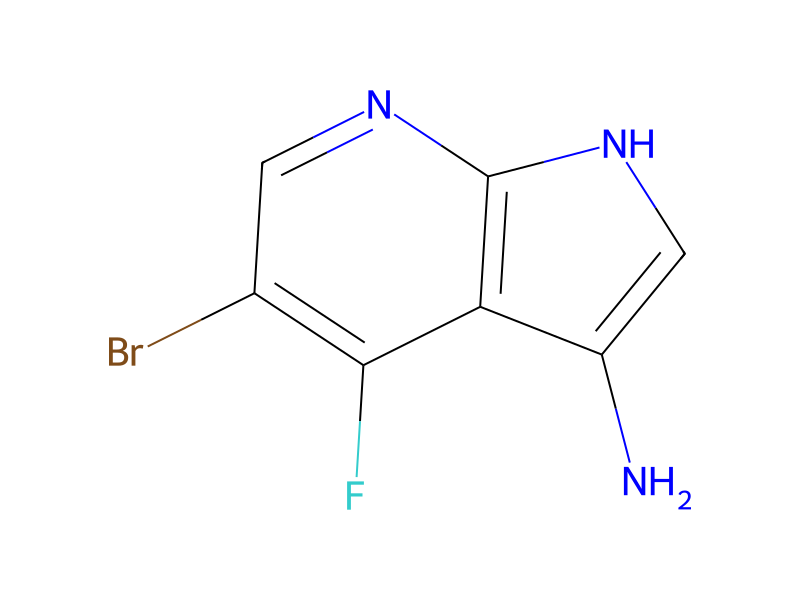
1-Chloro-2-methyl-1-oxopropan-2-yl acetate (215 mg, 1.30 mmol) in dry dichloromethane (2 mL) was added dropwise to a solution of 5-bromo-4-fluoro-1H-pyrrolo[2,3-b]pyridin-3-amine (250 mg, 1.087 mmol; Example 1, Step H) and triethylamine (550 mg, 0.757 mL, 5.43 mmol) in dry dichloromethane (10 mL) cooled on an ice-bath. The resulting solution was stirred at room temperature for 1 hour. The solvent was evaporated. The residue was then stirred in THF (10 mL), treated with an aqueous 2N LiOH solution (3 mL), and stirred at room temperature for 18 hours. The mixture was evaporated under reduced pressure, and the residue dissolved in EtOAc and washed with water (3×20 mL). The organic layer was dried over MgSO4, filtered and concentrated to give N-(5-bromo-4-fluoro-1H-pyrrolo[2,3-b]pyridin-3-yl)-2-hydroxy-2-methylpropanamide (289 mg, 84% yield) as a solid. 1H NMR (400 MHz, (CD3)2SO) δ 12.03 (br s, 1H), 9.27 (s, 1H), 8.36 (d, 1H), 7.69 (d, 1H), 5.84 (s, 1H), 1.37 (s, 6H); LCMS (APCI+) m/z 317.9 (M+H)+, Retention time=2.51 minutes.