Reaction equation

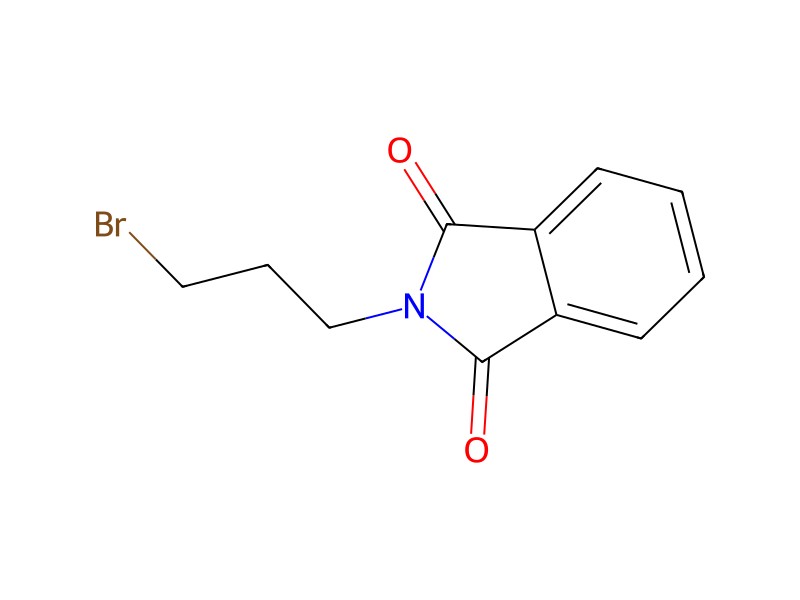
[Br:1][CH2:2][CH2:3][CH2:4][N:5]1[C:9](=[O:10])[C:8]2=[CH:11][CH:12]=[CH:13][CH:14]=[C:7]2[C:6]1=[O:15].[C:16]1([P:22]([C:29]2[CH:34]=[CH:33][CH:32]=[CH:31][CH:30]=2)[C:23]2[CH:28]=[CH:27][CH:26]=[CH:25][CH:24]=2)[CH:21]=[CH:20][CH:19]=[CH:18][CH:17]=1>C1(C)C=CC=CC=1>[Br-:1].[O:15]=[C:6]1[C:7]2[C:8](=[CH:11][CH:12]=[CH:13][CH:14]=2)[C:9](=[O:10])[N:5]1[CH2:4][CH2:3][CH2:2][P+:22]([C:23]1[CH:24]=[CH:25][CH:26]=[CH:27][CH:28]=1)([C:29]1[CH:34]=[CH:33][CH:32]=[CH:31][CH:30]=1)[C:16]1[CH:17]=[CH:18][CH:19]=[CH:20][CH:21]=1Participants
4
Reactant 2

Product 1

Reagents, catalysts & solvents 1

Procedure
A solution of N-(3-bromopropyl)phthalimide (25.0 g, 93.2 mmol) and triphenylphosphine (24.5 g, 93.2 mmol) in toluene (200 mL) was stirred and heated to reflux for 15 hours. The reaction mixture was cooled to ambient temperature and the resulting precipitate was collected by filtration, washed with toluene, and dried under vacuum to afford (3-(1,3-dioxoisoindolin-2-yl)propyl)triphenylphosphonium bromide as a white powder (17.9 g, 36% yield).
Workup
- temperatureheated
- temperatureto reflux for 15 hours
- filtrationthe resulting precipitate was collected by filtration
- washwashed with toluene
- customdried under vacuum
Sources & evidence
- ORD record
- ord-029bcb66b90a4de79901907d26cf2441
- Source dataset
- uspto-grants-2013_10
- Patent number
- US08569522B2
Linked notes
Loading…