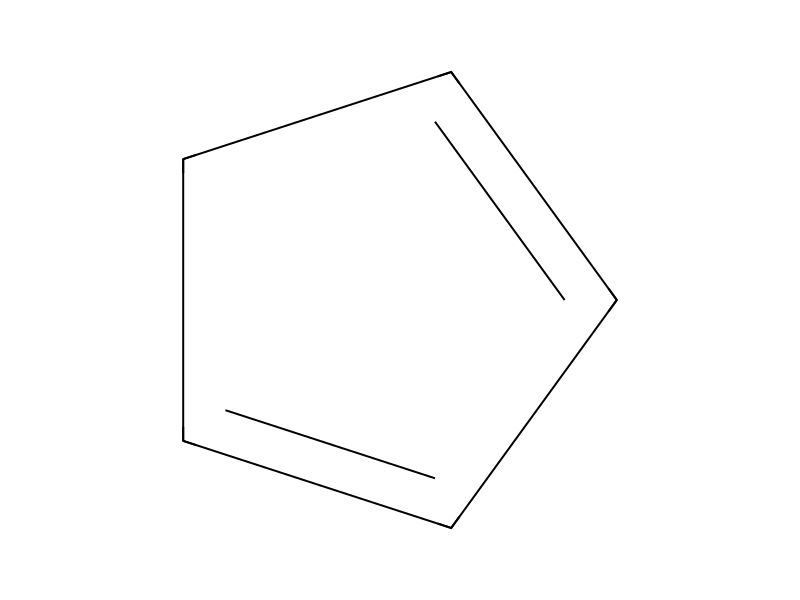
Under a nitrogen atmosphere, a reaction vessel equipped with a dropping funnel was charged with 40 mL of dry tetrahydrofuran and 2.15 mL (25.89 mmol) of cyclopentadiene. While cooling this solution to 0° C., 18 mL (28.47 mmol) of a 1.58 mol/L hexane solution of n-butyllithium was slowly added dropwise and the mixture was stirred. Subsequently, a dropping funnel was charged with a solution prepared by dissolving 5.00 g (19.91 mmol) of 4,4′-dichlorobenzophenone in 30 mL of tetrahydrofuran, and the solution was slowly added dropwise. The mixture was left to be stand so that the temperature of the mixture was at room temperature, and stirred for one day. This reaction solution was then subjected to extraction with diethyl ether. The organic layer was washed with 1 N hydrochloric acid, a saturated aqueous solution of sodium hydrogen carbonate and saturated brine, and then dried over magnesium sulfate. The solvent was removed by distillation under reduce pressure. The residue was purified by using a silica gel column to obtain a target product (yield 3.37 g (57%)). The target product was identified by 1H-NMR.