HomeMCPWorkbenchSkills
HomeWorkbenchNotificationsMe
llms.txt · MCP GuidePrivacy Policy · Terms of Service · Supportv1.8.3
  1. Home
  2. /Reaction

Potassium Carbonate → (S)-1-(5-cyclopropoxy-6-(1-cyclopropyl-1H-pyrazol-4-yl)-2-methyl-3,4-dihydroquinolin-1 (2H)-yl)ethanone

HRID 1051614
Print

Reaction equation

HRID 1051614 reaction equation
Br[C:2]1[C:3]([O:16][CH:17]2[CH2:19][CH2:18]2)=[C:4]2[C:9](=[CH:10][CH:11]=1)[N:8]([C:12](=[O:14])[CH3:13])[C@@H:7]([CH3:15])[CH2:6][CH2:5]2.[CH:20]1([N:23]2[CH:27]=[C:26](B3OC(C)(C)C(C)(C)O3)[CH:25]=[N:24]2)[CH2:22][CH2:21]1.C(=O)([O-])[O-].[K+].[K+]>C1C=CC(P(C2C=CC=CC=2)[C-]2C=CC=C2)=CC=1.C1C=CC(P(C2C=CC=CC=2)[C-]2C=CC=C2)=CC=1.Cl[Pd]Cl.[Fe+2].ClCCl.O1CCOCC1>[CH:17]1([O:16][C:3]2[C:2]([C:26]3[CH:25]=[N:24][N:23]([CH:20]4[CH2:22][CH2:21]4)[CH:27]=3)=[CH:11][CH:10]=[C:9]3[C:4]=2[CH2:5][CH2:6][C@H:7]([CH3:15])[N:8]3[C:12](=[O:14])[CH3:13])[CH2:19][CH2:18]1
ParticipantsConditionsProcedureWorkupSources & evidenceReaction notes

Participants

6

Reactant 3

HCID 11430Potassium CarbonateHCID 593271331-Cyclopropyl-4-(4,4,5,5-tetramethyl-1,3,2-dioxaborolan-2-yl)-1H-pyrazoleHCID 118086262(S)-1-(6-bromo-5-cyclopropoxy-2-methyl-3,4-dihydroquinolin-1(2H)-yl)ethanone

Product 1

HCID 118076189(S)-1-(5-cyclopropoxy-6-(1-cyclopropyl-1H-pyrazol-4-yl)-2-methyl-3,4-dihydroquinolin-1 (2H)-yl)ethanoneYield 19%

Reagents, catalysts & solvents 2

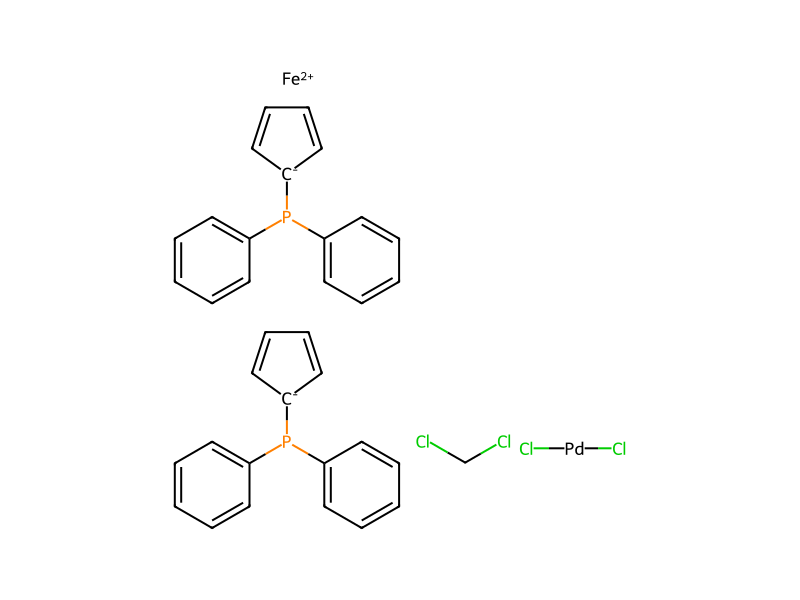
HCID 178418807HCID 178418807, compoundCatalystHCID 312751,4-DioxaneSolvent

Conditions

Temperature
80 °C

Procedure

A 1.5 mL reaction vial was charged with (S)-1-(6-bromo-5-cyclopropoxy-2-methyl-3,4-dihydroquinolin-1(2H)-yl)ethanone (0.019 g, 0.06 mmol) and 1,4-dioxane (50 μL). 1-cyclopropyl-4-(4,4,5,5-tetramethyl-1,3,2-dioxaborolan-2-yl)-1H-pyrazole (0.2 M solution in 1,4-dioxane, 540 μL, 0.108 mmol) and potassium carbonate (1 M solution in water, 180 μL, 0.18 mmol) were added, and the reaction mixture was purged with nitrogen. [1,1′-Bis(diphenylphosphino)ferrocene]dichloropalladium(II) dichloromethane adduct (0.02 M solution in 1,2-dichloroethane, 300 μL, 0.006 mmol) was added, and the reaction was purged with nitrogen and heated to 80° C. on a heater shaker overnight. The reaction was diluted with ethyl acetate and washed with 1 N aqueous sodium hydroxide solution. The aqueous layer was separated and washed with ethyl acetate, and the combined organic layers were concentrated under a stream of nitrogen. The crude product was purified by mass triggered preparatory HPLC. The product-containing fractions were combined and concentrated in a Genevac to afford (S)-1-(5-cyclopropoxy-6-(1-cyclopropyl-1H-pyrazol-4-yl)-2-methyl-3,4-dihydroquinolin-1 (2H)-yl)ethanone (0.0039 g, 19%). MS (ESI, pos. ion) m/z 352 [M+H]+.

Workup

  1. customA 1.5 mL reaction
  2. customthe reaction mixture was purged with nitrogen
  3. customthe reaction was purged with nitrogen
  4. additionThe reaction was diluted with ethyl acetate
  5. washwashed with 1 N aqueous sodium hydroxide solution
  6. customThe aqueous layer was separated
  7. washwashed with ethyl acetate
  8. concentrationthe combined organic layers were concentrated under a stream of nitrogen
  9. customThe crude product was purified by mass
  10. concentrationconcentrated in a Genevac

Sources & evidence

ORD record
ord-763a593667df4c26a7cc6a20994c0f93
Source dataset
uspto-grants-2016_07
DOI
10.6084/m9.figshare.5104873.v1
Patent number
US09388161B2

Reaction notes

On this pageParticipantsConditionsProcedureWorkupSources & evidenceReaction notes