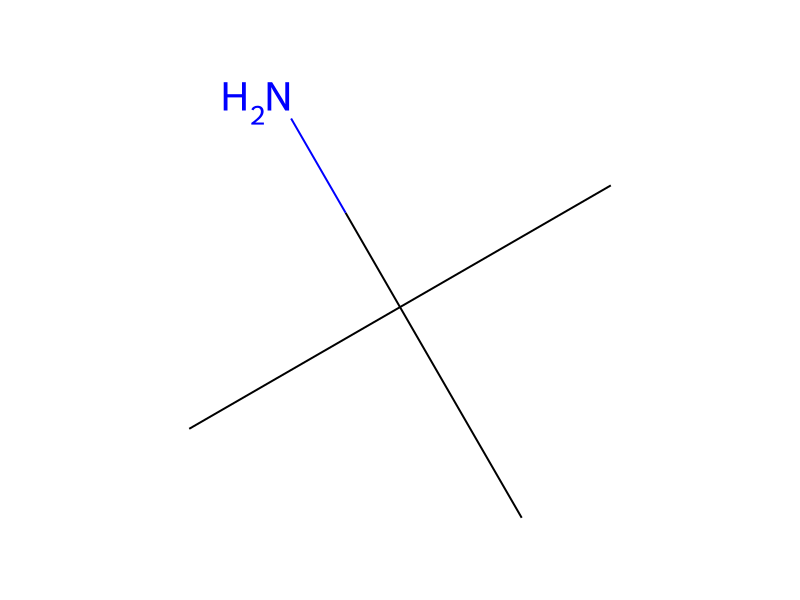
Tert-Butylamine → 8-bromo-N-(tert-butyl)-3-ethylquinoxalin-2-amine
HRID 1056176
Reaction equation

[Br:1][C:2]1[CH:11]=[CH:10][CH:9]=[C:8]2[C:3]=1[N:4]=[C:5](Cl)[C:6]([CH2:12][CH3:13])=[N:7]2.[C:15]([NH2:19])([CH3:18])([CH3:17])[CH3:16]>CS(C)=O>[Br:1][C:2]1[CH:11]=[CH:10][CH:9]=[C:8]2[C:3]=1[N:4]=[C:5]([NH:19][C:15]([CH3:18])([CH3:17])[CH3:16])[C:6]([CH2:12][CH3:13])=[N:7]2Participants
4
Reactant 2

Product 1

Reagents, catalysts & solvents 1

Procedure
A solution of 5-bromo-3-chloro-2-ethylquinoxaline (312a) (131 mg, 0.48 mmol) and t-butylamine (Aldrich) (0.25 mL, 2.41 mmol) in DMSO (1.0 mL) was stirred under argon in a sealed flask at 100° C. for 17 h. The reaction mixture was then cooled to RT and partitioned between Et2O (80 mL) and saturated aq. NaHCO3 (80 mL). The organic layer was separated and sequentially washed with water (50 mL) and brine (40 mL), then dried over Na2SO4, filtered, and concentrated in vacuo to provide 8-bromo-N-(tert-butyl)-3-ethylquinoxalin-2-amine (136 mg, 0.44 mmol, 92% yield) as a yellow-orange solid. 1H NMR (400 MHz, CDCl3) δ ppm 7.86 (1H, d, J=8.2 Hz), 7.82 (1H, dd, J=7.6, 1.2 Hz), 7.20 (1H, t, J=7.9 Hz), 4.87 (1H, br. s.), 2.84 (2H, q, J=7.4 Hz), 1.64 (9H, s), 1.42 (3H, t, J=7.4 Hz). m/z (ESI, +ve) 308.3/310.3 (M+H)+.