3-Amino-1,2-propanediol → 5-Cyano-3-[N-(2,3-dihydroxypropyl)carbamoyl]-2,4,6-triiodobenzoyl chloride
HRID 1065063
Reaction equation

[C:1]([C:3]1[C:4]([I:17])=[C:5]([C:14]([Cl:16])=[O:15])[C:6]([I:13])=[C:7]([C:11]=1[I:12])[C:8](Cl)=[O:9])#[N:2].[NH2:18][CH2:19][CH:20]([OH:23])[CH2:21][OH:22]>O1CCOCC1>[C:1]([C:3]1[C:11]([I:12])=[C:7]([C:8](=[O:9])[NH:18][CH2:19][CH:20]([OH:23])[CH2:21][OH:22])[C:6]([I:13])=[C:5]([C:4]=1[I:17])[C:14]([Cl:16])=[O:15])#[N:2]Participants
4
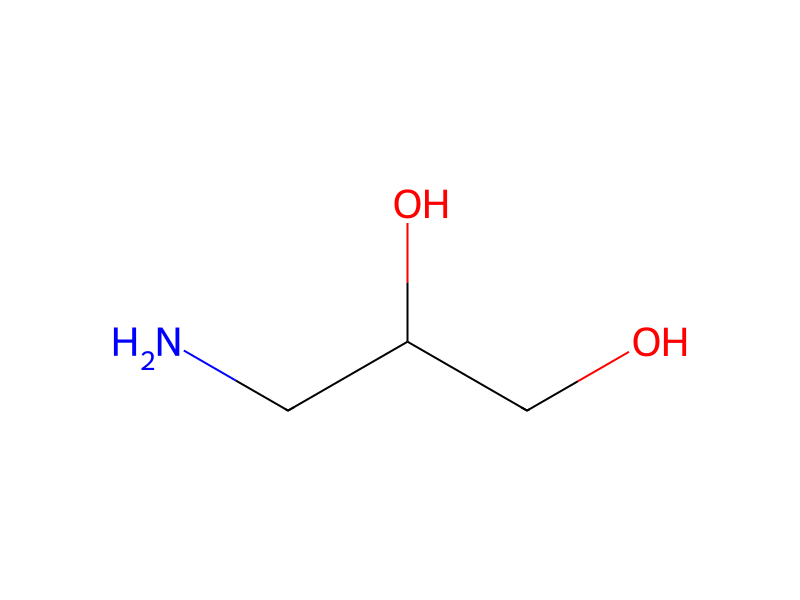



Procedure
18.1 g of 5-cyano-2,4,6-triiodoisophthalic acid dichloride is combined in 750 ml of dioxane at 80° C. with 7.1 g of 1-amino-2,3-propanediol and stirred for 2 hours. The mixture is then separated from the precipitated hydrochloride of 1-amino-2,3-propanediol, and the filtrate is concentrated under vacuum. The residue is extracted by boiling with 800 ml of ethyl acetate. After concentration and cooling, 11.7 g (59% of theory) of 5-cyano-3-[N-(2,3-dihydroxypropyl)carbamoyl]-2,4,6-triiodobenzoyl chloride is crystallized from the extract as a white powder; mp 285°-288° C.