HomeMCPWorkbenchSkills
HomeWorkbenchNotificationsMe
llms.txt · MCP GuidePrivacy Policy · Terms of Service · Supportv1.8.3
  1. Home
  2. /Compound

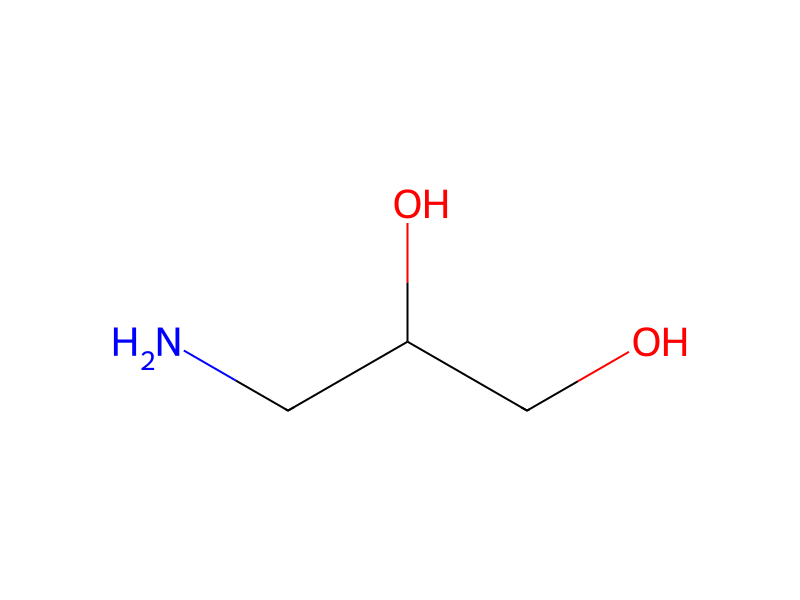
3-Amino-1,2-propanediol

HCID 73561
New reaction
Print
Basic informationOverviewNames & identifiersPropertiesSafety & regulationChemistry & industryRelated reactionsCompound notes
Substructure searchFind similar structures

Basic information

CAS
616-30-8
Standard SMILES
NCC(O)CO
InChIKey
KQIGMPWTAHJUMN-UHFFFAOYSA-N
Molecular formula
C3H9NO2
Average molar mass
91.11 g/mol
Monoisotopic mass
91.06332853

Overview

structure given in first source; RN given refers to parent cpd

Names & identifiers

Preferred name
3-Amino-1,2-propanediol
IUPAC
3-aminopropane-1,2-diol
English name
3-Amino-1,2-propanediol
Molecular formula
C3H9NO2
Molecular weight
91.11

Names & synonyms

3-Amino-1,2-propanediol616-30-81-Aminoglycerol1,2-Propanediol, 3-amino-2,3-Dihydroxypropylamine1-AminopropanediolaminopropanediolRH369P864XNSC-67381DTXSID30862294RefChem:92848DTXCID90811081
Show more names
APD3-amino-1,2-propanediol (APD)3--1,2-
210-475-83-Aminopropane-1,2-diol1-Amino-2,3-propanediol2,3-Propandiol-1-amine3-Amino-1,2-propandiolisoserinolMFCD00008140C3H9NO2

Database identifiers

CAS
616-30-8
PubChem CID
73561
DTXSID
DTXSID30862294
UNII
RH369P864X
EC Number
210-475-8
Nikkaji
J1.661F

Properties

Computed structural properties

XLogP
-2
Topological polar surface area
66.5 Ų
Hydrogen bond donors
3
Hydrogen bond acceptors
3
Rotatable bonds
2
Heavy atoms
6
Formal charge
0
Complexity
32

Experimental & physicochemical properties

Food Contact SubstancesFCS -> FDA Inventory of Food Contact Substances Listed in 21 CFR

Physicochemical properties

Melting point
55 · 55-57 °C
Boiling point
264 · 264-265 °C/739 mmHg (lit.)
Density
1.175 g/mL · 1.175 g/mL at 25 °C (lit.)
vapor pressure
1 hPa · <1 hPa (20 °C)
refractive index
20 · n 20/D 1.492 (lit.)
Flash point
155 °C · 155 °C
storage temp.
30 °C · Store below +30°C.
solubility
1000 g/l · >1000g/l soluble
pka
12.11 · 12.11±0.35(Predicted)
form
powder to lump to clear liquid
color
White or Colorless to Light orange to Yellow
Specific Gravity
1.175 · 1.175
PH
11 · 11 (100g/l, H2O, 20℃)
Water Solubility
soluble
Sensitive
Hygroscopic
BRN
1719121 · 1719121
Cosmetics Ingredients Functions
BUFFERING
InChI
1S/C3H9NO2/c4-1-3(6)2-5/h3,5-6H,1-2,4H2
InChIKey
KQIGMPWTAHJUMN-UHFFFAOYSA-N
SMILES
NCC(O)CO
LogP
-2.079 · -2.079 (est)
CAS DataBase Reference
616 · 616-30-8(CAS DataBase Reference)
Indirect Additives used in Food Contact Substances
3 · 3-AMINO-1,2-PROPANEDIOL
FDA 21 CFR
175.105 · 175.105
FDA UNII
369 P864X · RH369P864X
NIST Chemistry Reference
3 · 3-Amino-1,2-propanediol(616-30-8)
EPA Substance Registry System
1 · 1,2-Propanediol, 3-amino- (616-30-8)
UNSPSC Code
12352104 · 12352104
NACRES
22 · NA.22
Symbol(GHS)
5 · GHS05
Signal word
Danger
Hazard statements
314 · H314
Precautionary statements
280 · P280-P303+P361+P353-P304+P340+P310-P305+P351+P338-P363-P405
PPE
Faceshields, Gloves, Goggles, type ABEK (EN14387) respirator filter
Hazard Codes
C,Xi
Risk Statements
34 · 34-36/37/38
Safety Statements
26 · 26-36/37/39-45-36
RIDADR
2735 · UN 2735 8/PG 2
WGK Germany
2 · 2
RTECS
2800000 · TY2800000
F
10 · 10-21
Hazard Note
Corrosive
TSCA
TSCA listed
HazardClass
8 · 8
PackingGroup
III
HS Code
2922199090 · 2922199090
Storage Class
8 A · 8A - Combustible corrosive hazardous materials
Hazard Classifications
1 B · Skin Corr. 1B
Toxicity
50 orally · LD50 orally in Rabbit: 7500 mg/kg
REACH Registrations
Active
Limited Quantities
1 L · 1.0 L (0.3 gallons) (liquid) or 1 Kg (2.2 lbs) (solid)
Excepted Quantities
Max Inner Pack (30g or 30ml) and Max Outer Pack (500g or 500ml)

Safety & regulation

Safety information is for reference only and does not replace the supplier’s Safety Data Sheet (SDS), applicable regulations, or professional assessment.

GHS classification

GHS Classification · 4 items

Danger

H314 (94%): Causes severe skin burns and eye damage [Danger Skin corrosion/irritation]

P260, P264, P264+P265, P280, P301+P330+P331, P302+P361+P354, P304+P340, P305+P354+P338, P316, P317, P321, P363, P405, and P501 (click each P-code to see the statement)

Aggregated GHS information provided per 184 reports by companies from 8 notifications to the ECHA C&L Inventory. Each notification may be associated with multiple companies.

Hazard information

Regulatory Information · 3 items

Chemical: 1,2-Propanediol, 3-amino-

REACH registered substance: 3-aminopropane-1,2-diol (EC: 210-475-8)

1,2-Propanediol, 3-amino-: Does not have an individual approval but may be used as a component in a product covered by a group standard. It is not approved for use as a chemical in its own right.

Hazard Classes and CategoriesSkin Corr. 1B (94%)

Safety data

F
10-21
PPE
Faceshields, Gloves, Goggles, type ABEK (EN14387) respirator filter
wgk
2
tsca
TSCA listed
rtecs
TY2800000
ridadr
UN 2735 8/PG 2
hs_code
2922199090
Toxicity
LD50 orally in Rabbit: 7500 mg/kg
risk_code
34-36/37/38
Signal word
Danger
Symbol(GHS)
GHS05
hazard_code
C,Xi
hazard_note
Corrosive
safety_code
26-36/37/39-45-36
hazard_class
8
Storage Class
8A - Combustible corrosive hazardous materials
packing_group
III
Hazard statements
H314
Limited Quantities
1.0 L (0.3 gallons) (liquid) or 1 Kg (2.2 lbs) (solid)
Excepted Quantities
Max Inner Pack (30g or 30ml) and Max Outer Pack (500g or 500ml)
REACH Registrations
Active
Hazard Classifications
Skin Corr. 1B
Precautionary statements
P280-P303+P361+P353-P304+P340+P310-P305+P351+P338-P363-P405

Chemistry & industry

Uses & manufacturing

General Manufacturing Information1,2-Propanediol, 3-amino-: ACTIVE
Applications · 4 items

Description3-Amino-1,2-propanediol (APD) is a calcium metabolism regulator useful in the treatment of Paget's disease, tumor-induced hypercalcemia and other bone disorders involving increased osteoclastic activity.

Uses3-Amino-1,2-propanediol is used in the preparation of iohexol, which is a X-CT non-ionic contrast medium. It acts as a starting material in the production of specialty materials.

UsesA chiral glycerol derivative, namely 3-amino-1,2-propanediol, was employed for as the hydrogen bond donor (HBD) in the design of a new deep eutectic solvent (DES) with choline chloride acting as the hydrogen bond acceptor (HBA). The novel mixture was characterized and unambiguously classified as a DES[4].

General Description3-Amino-1,2-propanediol is a chiral glycerol derivative. It could used as a hydrogen bond donor in the design of a new deep eutectic solvent which have emerged as a suitable alternative to VOCs (volatile organic compounds) for diverse practical applications including, among others, drug delivery, electrochemistry, material design, extractions and, of course, organic reactions, alone or together twith other sustainable reaction-media[1]. It can also used as a core present in antiviral compounds to skeleton to design a novel class of anti-adenovirus agents[2].

Preparation methods

Preparation3-Amino-1,2-propanediol is synthesized by reacting 3-chloro-1,2-propanediol (CPD) with ammonia in alkaline environment by adding sodium hydroxide. Afterwards, the product undergoes a series of purification steps.

Upstream & downstream products

Upstream raw materials

Ammonium hydroxidePotassium hydroxideMethanol3-Chloro-1,2-propanediolEpichlorohydrinDL-GLYCERALDEHYDEAmmoniaSodium hydroxide

Related reactions

354 records
New reaction record
HRID 3070 reaction equation
HRID 3070As reactant
HRID 25054 reaction equation
HRID 25054As reactant
HRID 34571 reaction equation
HRID 34571As reactant
HRID 41835 reaction equation
HRID 41835As reactant
HRID 64610 reaction equation
HRID 64610As reactant
HRID 64611 reaction equation
HRID 64611As reactant
HRID 64612 reaction equation
HRID 64612As reactant
HRID 71562 reaction equation
HRID 71562As reactant
PreviousPage 1 of 45

Compound notes

On this pageBasic informationOverviewNames & identifiersPropertiesSafety & regulationChemistry & industryRelated reactionsCompound notes