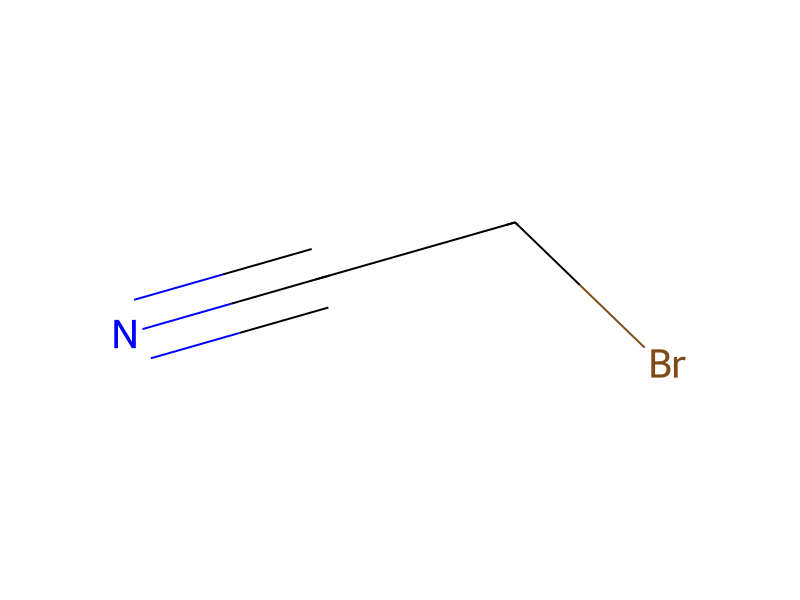
Bromoacetonitrile → HCID 18702190, compound
HRID 1075688
Reaction equation

[H-].[Na+].[Cl:3][C:4]1[CH:9]=[CH:8][C:7]([S:10]([CH2:13][C:14](=[O:16])[CH3:15])(=[O:12])=[O:11])=[CH:6][CH:5]=1.Br[CH2:18][C:19]#[N:20]>>[Cl:3][C:4]1[CH:5]=[CH:6][C:7]([S:10]([CH:13]([CH2:18][C:19]#[N:20])[C:14](=[O:16])[CH3:15])(=[O:11])=[O:12])=[CH:8][CH:9]=1Participants
4



Conditions
- Temperature
- -15 °C
Procedure
To a 300 mL reaction flask was added 2.4 g (59.3 mmole) sodium hydride (60% dispersion in oil) and 10 mL hexanes. The hexanes were removed by pipette and replaced by 60 mL dry tetrahydrofluran (THF). The suspension was cooled to -15° C. and a solution of 12.0 g (51.6 mmole) 4-chlorophenylsulfonyl acetone in 50 mL THF was added via addition funnel over 20 minutes maintaining the reaction temperature below -12° C. The resulting yellow solution was removed from the cold bath and stirred at room temperature for 30 min. The solution was recooled to -5° C. and 3.8 mL (54.1 mmole) bromoacetonitrile was added dropwise via addition funnel. After 5 min, the reaction mixture was removed from the cold bath and stirred at room temperature overnight. The reaction was quenched with 1 mL of saturated ammonium chloride and transferred with 100 mL of dichloromethane to a separatory funnel containing 100 mL brine. The organic layer was separated and the aqueous layer was back extracted once with 50 mL more dichloromethane. The combined organics were then dried with sodium sulfate, filtered, concentrated, and chromatographed through a bed of silica gel using 1:1 hexane: dichloromethane. Isolation gave 8.2 g (59% yield) of 3-(4-chlorophenylsulfonyl)-4-cyanobutan-2-one, a yellow oil that was 90% pure by HPLC. 1H NMR (CDCl3) indicated desired product as the major component: δ7.6 (m, 4H), 4.42 (dd, 1H), 2.78 (m, 2H), 2.48 (s, 3H).