Reaction equation
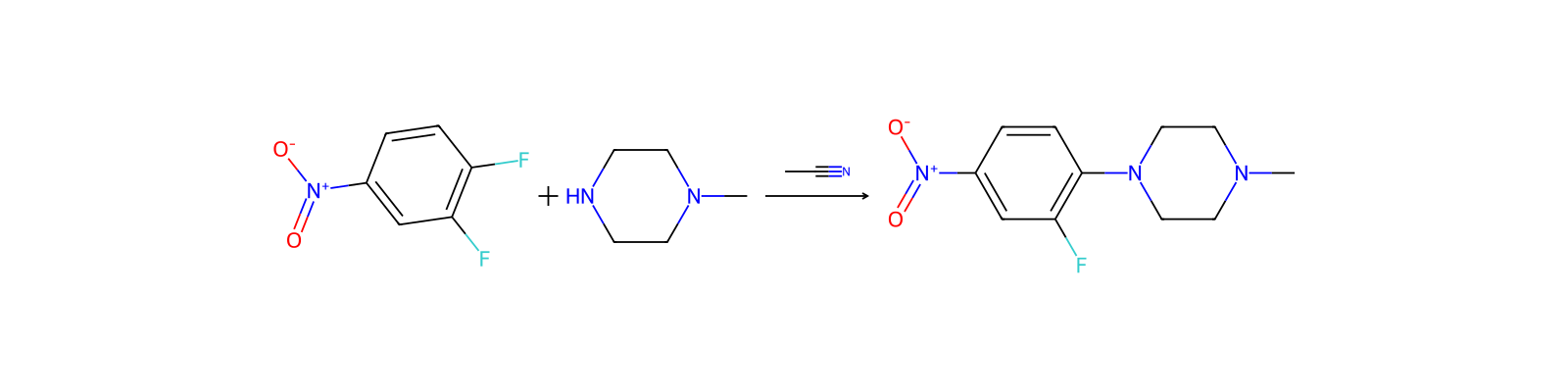
[F:1][C:2]1[CH:3]=[C:4]([N+:9]([O-:11])=[O:10])[CH:5]=[CH:6][C:7]=1F.[CH3:12][N:13]1[CH2:18][CH2:17][NH:16][CH2:15][CH2:14]1>C(#N)C>[F:1][C:2]1[CH:3]=[C:4]([N+:9]([O-:11])=[O:10])[CH:5]=[CH:6][C:7]=1[N:16]1[CH2:17][CH2:18][N:13]([CH3:12])[CH2:14][CH2:15]1Participants
4
Reactant 2


Product 1

Reagents, catalysts & solvents 1

Procedure
A solution of 3,4-difluoronitrobenzene (12.00 g, 75.4 mmol) (Aldrich) and N-methylpiperazine (18.89 g, 188.6 mmol) in acetonitrile (150 mL) was heated at reflux for 3 h. The reaction mixture was allowed to stand overnight at room temperature, then the solvent was evaporated under reduced pressure and the residue was partitioned between water and ethyl acetate (200 mL each). The aqueous layer was extracted with ethyl acetate (3×200 mL) and the combined organic layers were then washed with water and brine (200 mL each), dried (MgSO4), filtered, and evaporated under reduced pressure to give 1-(2-fluoro-4-nitrophenyl)-4-methylpiperazine as a pale brown solid (17.5 g, 97%, mp 68–70° C.).
Workup
- temperatureat reflux for 3 h
- customthe solvent was evaporated under reduced pressure
- customthe residue was partitioned between water and ethyl acetate (200 mL each)
- extractionThe aqueous layer was extracted with ethyl acetate (3×200 mL)
- washthe combined organic layers were then washed with water and brine (200 mL each)
- dry with materialdried (MgSO4)
- filtrationfiltered
- customevaporated under reduced pressure
Sources & evidence
- ORD record
- ord-7fc712df9bea40238aa90ddb61a7176d
- Source dataset
- uspto-grants-2006_08
- Patent number
- US07094896B2
Linked notes
Loading…