HomeMCPWorkbenchSkills
HomeWorkbenchNotificationsMe
llms.txt · MCP GuidePrivacy Policy · Terms of Service · Supportv1.8.3
  1. Home
  2. /Reaction

Pyridine → (-)-(1R,2S)-2-phenylcyclohexyl chloroacetate

HRID 1085322
Print

Reaction equation

HRID 1085322 reaction equation
[C:1]1([C@@H:7]2[CH2:12][CH2:11][CH2:10][CH2:9][C@H:8]2[OH:13])[CH:6]=[CH:5][CH:4]=[CH:3][CH:2]=1.[Cl:14][CH2:15][C:16](Cl)=[O:17].N1C=CC=CC=1>CN(C)C1C=CN=CC=1.C(Cl)Cl>[Cl:14][CH2:15][C:16]([O:13][C@@H:8]1[CH2:9][CH2:10][CH2:11][CH2:12][C@H:7]1[C:1]1[CH:6]=[CH:5][CH:4]=[CH:3][CH:2]=1)=[O:17]
ParticipantsProcedureSources & evidenceReaction notes

Participants

6

Reactant 3

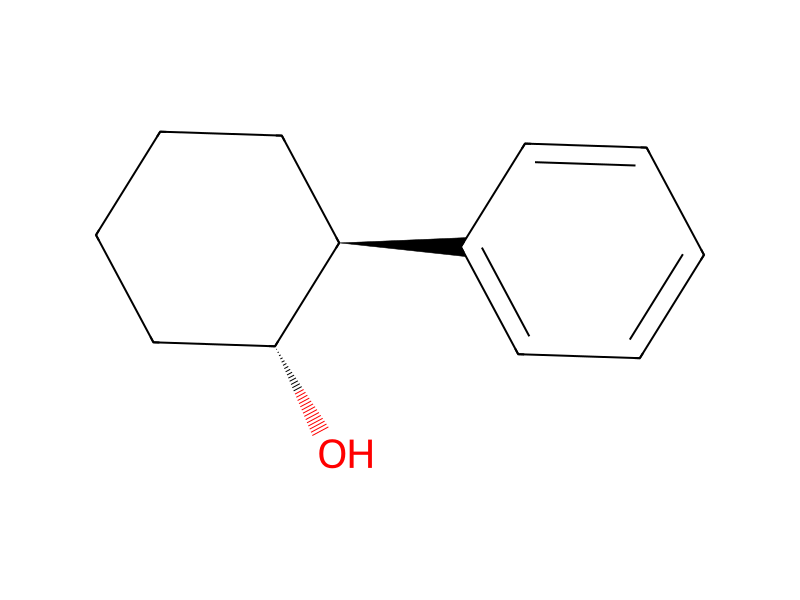
HCID 1049PyridineHCID 6577Chloroacetyl chlorideHCID 102793rel-(1R,2S)-2-Phenylcyclohexanol

Product 1

HCID 14295383(-)-(1R,2S)-2-phenylcyclohexyl chloroacetate

Reagents, catalysts & solvents 2

HCID 142844-(Dimethylamino)pyridineCatalyst
HCID 6344
Dichloromethane
Solvent
2×

Procedure

In the next step, (±)-trans-2-phenylcyclohexanol is reacted with chloroacetyl chloride at reflux in a basic solvent such as a mixture of methylene chloride and pyridine or, more preferably, 4-dimethylaminopyridine and methylene chloride. The resulting (±)-trans-2-phenylcyclohexyl chloroacetate of the formula ##STR29## can be isolated by conventional means such as extraction followed by distillation of the organic layer.

Sources & evidence

ORD record
ord-a3e42356f5aa4e7588e7b4d3943edfe1
Source dataset
uspto-grants-1991_04
DOI
10.6084/m9.figshare.5104873.v1
Patent number
US05008411

Reaction notes

On this pageParticipantsProcedureSources & evidenceReaction notes