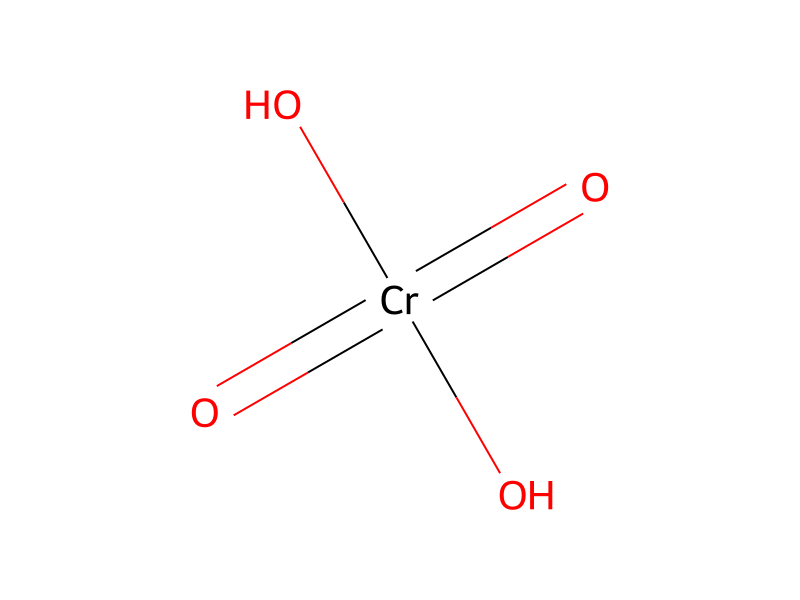
Chromic Acid → HCID 15058687, compound
HRID 1087896
Reaction equation

[F:1][CH2:2][CH2:3][O:4][C:5]1[C:12]([O:13][CH2:14][CH2:15][F:16])=[CH:11][CH:10]=[CH:9][C:6]=1[CH:7]=[O:8].[Cr](O)(O)(=O)=[O:18]>CC(C)=O.Cl>[F:1][CH2:2][CH2:3][O:4][C:5]1[C:12]([O:13][CH2:14][CH2:15][F:16])=[CH:11][CH:10]=[CH:9][C:6]=1[C:7]([OH:18])=[O:8]Participants
5
Reactant 2

Product 1

Reagents, catalysts & solvents 2


Procedure
To a stirred solution of 3.0 grams (0.013 mole) of 2,3-di(2-fluoroethoxy)benzaldehyde in 10 ml of acetone was added 4.9 ml of a 2.6 M solution of aqueous chromic acid in acetone (Jones' reagent). The mixture was stirred at room temperature for 30 minutes, and the solvent was removed by evaporation under reduced pressure leaving a residue. This residue was dissolved in 30 ml of 1 N hydrochloric acid, and the acidic solution was extracted with five 30 ml portions of diethyl ether. The combined organic phase was extracted with three 35 ml portions of an aqueous, 10% sodium hydroxide solution. The basic extracts were combined and acidified. The acidic solution was extracted with five 30 ml portions of diethyl ether. The extracts were combined and washed with two 25 ml portion of an aqueous, saturated sodium chloride solution. The washed organic phase was dried over anhydrous magnesium sulfate and filtered. The filtrate was evaporated under reduced pressure leaving a solid residue. This solid was recrystallized from toluene to yield 1.4 gram of 2,3-di(2-fluoroethoxy)benzoic acid, mp 104°-105° C.