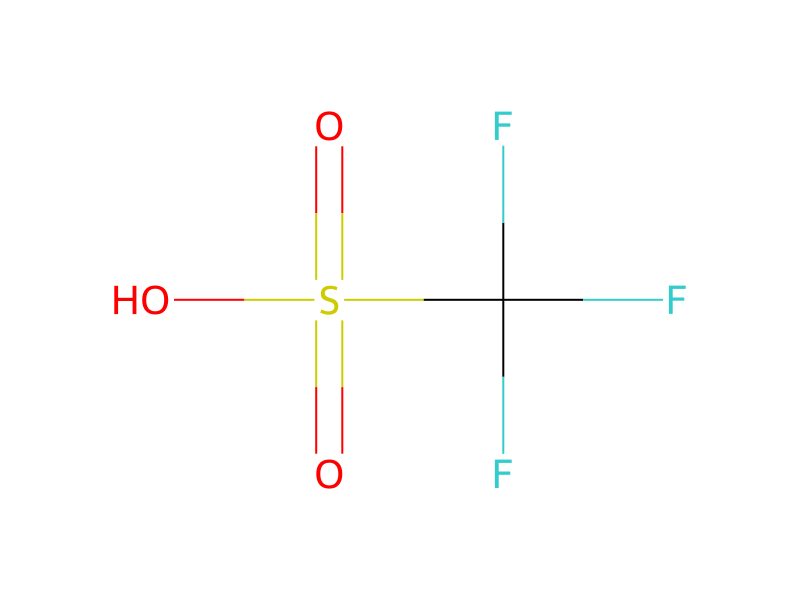
[Cl:1][C:2]1[C:7]([C:8]#[N:9])=[CH:6][N:5]=[C:4]2[NH:10][CH:11]=[CH:12][C:3]=12.FC(F)(F)S(O)(=O)=O.[F:21][C:22]1[C:30]([N+:31]([O-:33])=[O:32])=[CH:29][CH:28]=[C:27]([F:34])[C:23]=1[C:24](Cl)=[O:25]>>[Cl:1][C:2]1[C:7]([C:8]#[N:9])=[CH:6][N:5]=[C:4]2[NH:10][CH:11]=[C:12]([C:24](=[O:25])[C:23]3[C:27]([F:34])=[CH:28][CH:29]=[C:30]([N+:31]([O-:33])=[O:32])[C:22]=3[F:21])[C:3]=12In a vial, 4-chloro-1H-pyrrolo[2,3-b]pyridine-5-carbonitrile (50, 500 mg, 2.82 mmol) is cooled in an ice water bath, and trifluoromethanesulfonic acid (2.49 mL, 28.15 mmol) is added. The solution is stirred at 0-5° C. for 5 minutes, then 2,6-difluoro-3-nitro-benzoyl chloride (49, 748.5 mg, 3.38 mmol) is added. The reaction is stirred at 0-5° C. for 1 hour, then warmed to room temperature and stirred for 4 days. The reaction is quenched with 5 mL of methanol, and stirred at room temperature for 1 hour. The reaction is poured into saturated aqueous sodium bicarbonate and extracted with ethyl acetate. The organic layer is washed with water, brine, dried with magnesium sulfate, filtered and the filtrate is concentrated under vacuum. The resulting material is purified by silica gel column chromatography, eluting with 0-100% ethyl acetate in hexane. Appropriate fractions are combined and concentrated under vacuum to provide the desired compound (51, 134 mg).