HomeMCPWorkbenchSkills
HomeWorkbenchNotificationsMe
llms.txt · MCP GuidePrivacy Policy · Terms of Service · Supportv1.8.0
  1. Home
  2. /Reaction

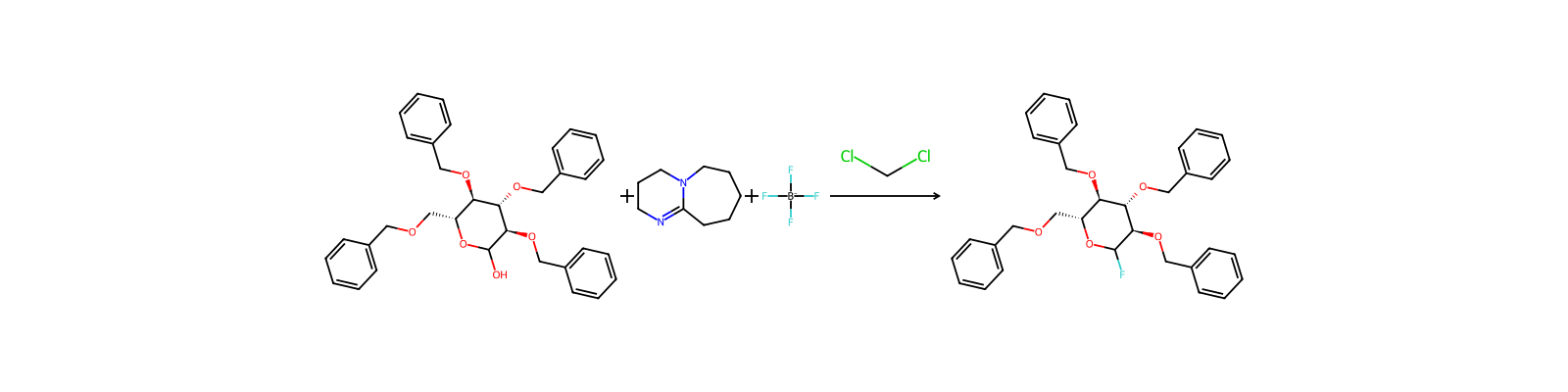
Tetrafluoroborate → 2,3,4,6-Tetra-O-benzyl-D-glucopyranosyl Fluoride

HRID 1193003
Notes
Print preview

Reaction equation

HRID 1193003 reaction equation
[CH2:1]([O:8][C@@H:9]1[C@@H:15]([O:16][CH2:17][C:18]2[CH:23]=[CH:22][CH:21]=[CH:20][CH:19]=2)[C@H:14]([O:24][CH2:25][C:26]2[CH:31]=[CH:30][CH:29]=[CH:28][CH:27]=2)[C@@H:13]([CH2:32][O:33][CH2:34][C:35]2[CH:40]=[CH:39][CH:38]=[CH:37][CH:36]=2)[O:12][CH:10]1O)[C:2]1[CH:7]=[CH:6][CH:5]=[CH:4][CH:3]=1.C1CCN2C(=NCCC2)CC1.[F:52][B-](F)(F)F>ClCCl>[CH2:1]([O:8][C@@H:9]1[C@@H:15]([O:16][CH2:17][C:18]2[CH:23]=[CH:22][CH:21]=[CH:20][CH:19]=2)[C@H:14]([O:24][CH2:25][C:26]2[CH:31]=[CH:30][CH:29]=[CH:28][CH:27]=2)[C@@H:13]([CH2:32][O:33][CH2:34][C:35]2[CH:40]=[CH:39][CH:38]=[CH:37][CH:36]=2)[O:12][CH:10]1[F:52])[C:2]1[CH:7]=[CH:6][CH:5]=[CH:4][CH:3]=1
ParticipantsProcedureWorkupSources & evidenceReaction notes

Participants

5

Reactant 3

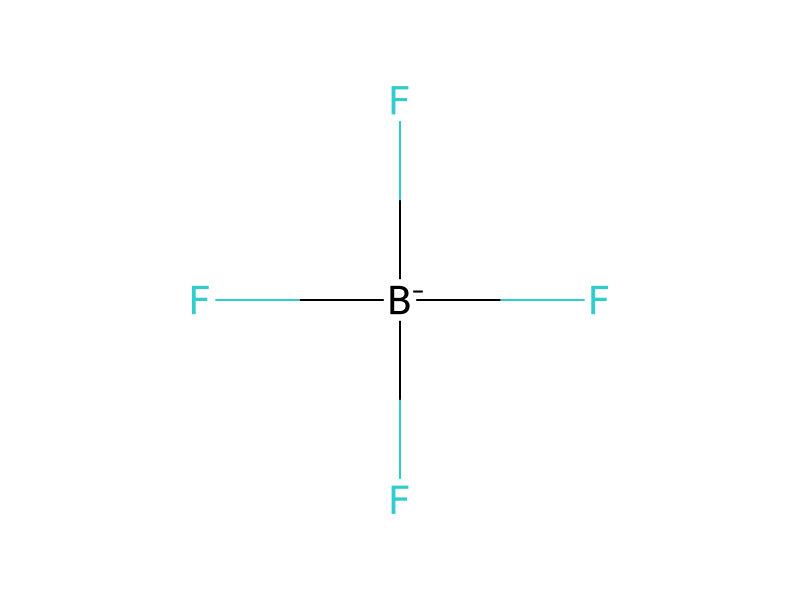
HCID 26255TetrafluoroborateHCID 811841,8-Diazabicyclo(5.4.0)undec-7-eneHCID 109405022,3,4,6-Tetrakis-O-(phenylmethyl)-D-glucopyranose

Product 1

HCID 109516702,3,4,6-Tetra-O-benzyl-D-glucopyranosyl Fluoride

Reagents, catalysts & solvents 1

HCID 6344DichloromethaneSolvent

Procedure

To a solution of 2,3,4,6-tetra-O-benzyl-D-glucopyranose (100 mg, 0.18 mmol) and DBU (44 μL, 0.28 mmol) in dichloromethane (0.5 mL) is added diethylaminodifluorosulfinium tetrafluoroborate (68 mg, 0.28 mmol) at room temperature and under nitrogen. After 90 min of stirring, the reaction mixture is quenched at room temperature with a 5% aqueous sodium bicarbonate solution, stirred for 15 min, and the resulting mixture is extracted twice using dichloromethane. The organic phases are combined, dried over magnesium sulfate and filtered through a pad of silica gel. Solvents are evaporated to provide 2,3,4,6-tetra-O-benzyl-D-glucopyranosyl fluoride (96 mg, 96%, β:α anomers in a 1.1:1 ratio respectively) as a foam. 1H NMR (CDCl3, 300 MHz) δ 7.47-7.15 (m, 20H), 5.61 (dd, 2JH-F=53.2 Hz, 3JH-H=2.3 Hz, 0.48H, α-anomer), 5.31 (dd, 2JH-F=51.8 Hz, 3JH-H=6.4 Hz, 0.52H, β-anomer), 5.07-4.48 (m, 8H), 4.11-3.54 (m, 6H); 19F NMR (CDCl3, 282 MHz) δ −138.0 (dd, 1JF-H=53.4 Hz, 2JF-H=10.6 Hz, β-F), −149.44 (dd, 1JF-H=54.4 Hz, 2JF-H=25.8 Hz, α-F); 13C NMR (CDCl3, 75 MHz) δ 138.5, 138.3, 138.1, 137.9, 137.5, 128.6, 128.5, 128.2, 128.1, 128.0, 127.9, 127.8, 112.8 (d, 1JC-F=215.2 Hz, β-anomer), 108.6 (d, 1JC-F=228.7 Hz, α-anomer), 83.6, 83.4, 81.7, 81.5, 81.4, 79.5, 79.2, 77.5, 77.1, 77.0, 77.7, 75.9, 75.5, 75.2, 75.0, 74.9, 74.8, 74.5, 73.6, 73.5, 72.7, 68.4, 67.8.

Workup

  1. customthe reaction mixture is quenched at room temperature with a 5% aqueous sodium bicarbonate solution
  2. stirringstirred for 15 min
  3. extractionthe resulting mixture is extracted twice using dichloromethane
  4. dry with materialdried over magnesium sulfate
  5. filtrationfiltered through a pad of silica gel
  6. customSolvents are evaporated

Sources & evidence

ORD record
ord-413aca3327ac47e2aa31ba0b074f7a81
Source dataset
uspto-grants-2014_03
DOI
10.6084/m9.figshare.5104873.v1
Patent number
US08680332B2

Reaction notes

Loading…

On this pageParticipantsProcedureWorkupSources & evidenceReaction notes