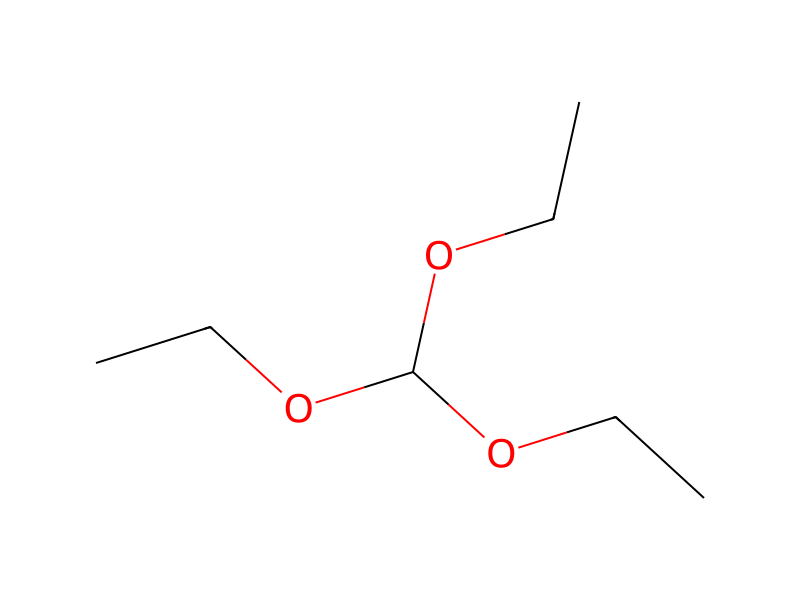
Ethyl orthoformate → 4-Cyano-5-ethoxymethyleneamino-1-(2,3,4-trichlorophenyl)pyrazole
HRID 1249127
Reaction equation

[NH2:1][C:2]1[N:6]([C:7]2[CH:12]=[CH:11][C:10]([Cl:13])=[C:9]([Cl:14])[C:8]=2[Cl:15])[N:5]=[CH:4][C:3]=1[C:16]#[N:17].O.C1(C)C=CC(S(O)(=O)=O)=CC=1.[CH2:30]([O:32][CH:33](OCC)OCC)[CH3:31]>>[C:16]([C:3]1[CH:4]=[N:5][N:6]([C:7]2[CH:12]=[CH:11][C:10]([Cl:13])=[C:9]([Cl:14])[C:8]=2[Cl:15])[C:2]=1[N:1]=[CH:33][O:32][CH2:30][CH3:31])#[N:17]Participants
4


Procedure
A mixture of 5-amino-4-cyano-1-(2,3,4-trichlorophenyl)pyrazole (10 g) and p-toluenesulphonic acid hydrate (0.1 g) in triethylorthoformate (40 ml) was heated at reflux for 1 hour. After cooling, the reaction mixture was evaporated to dryness. The residue was dissolved in dichloromethane and saturated aqueous sodium bicarbonate solution was added. The organic phase was removed, dried over anhydrous magnesium sulphate and evaporated to give a colourless solid which was recrystallised from a mixture of ethyl acetate and hexane to give 4-cyano-5-ethoxymethyleneamino-1-(2,3,4-trichlorophenyl)pyrazole (11.0 g), m.p. 131°-132° C., in the form of colourless crystals.