Reaction equation

[C:1]1([C:7]2[CH:8]=[CH:9][C:10]([C:19](OCC)=[O:20])=[N:11][C:12]=2[C:13]2[CH:18]=[CH:17][CH:16]=[CH:15][CH:14]=2)[CH:6]=[CH:5][CH:4]=[CH:3][CH:2]=1.CC(C[AlH]CC(C)C)C>C(Cl)Cl>[C:1]1([C:7]2[CH:8]=[CH:9][C:10]([CH:19]=[O:20])=[N:11][C:12]=2[C:13]2[CH:14]=[CH:15][CH:16]=[CH:17][CH:18]=2)[CH:2]=[CH:3][CH:4]=[CH:5][CH:6]=1Participants
4
Reactant 2

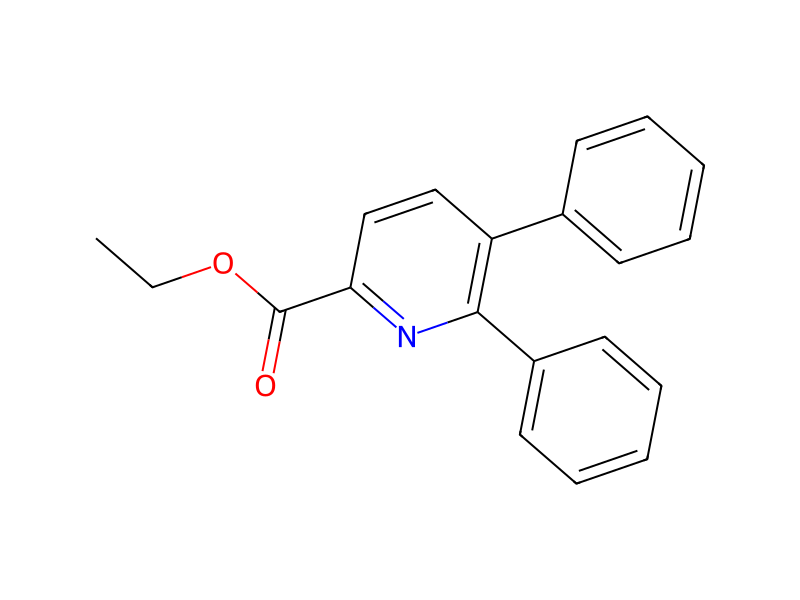
Product 1

Reagents, catalysts & solvents 1

Procedure
General Procedure L. To a solution of ethyl 5,6-diphenylpyridine-2-carboxylate (Compound 21, 145 mg, 0.48 mmol) in CH2Cl2 (5 ml) at −78° C. was added DIBAL-H (0.72 ml, 0.72 mmol, 1.0 M in Toluene) and the mixture was stirred between −78° C. and −60° C. for 1 hour under argon. The reaction was quenched with aq, NH4Cl, diethyl ether and 400 mg Celite were added, and the mixture was stirred at room temperature 30 min. The solid was filtered off and rinsed with ether, and the combined filtrate was concentrated in vacuo, and the residue was purified by column chromatography (silica gel, 15% ethyl acetate in hexane) to produce the title compound.
Workup
- customThe reaction was quenched with aq, NH4Cl, diethyl ether and 400 mg Celite
- additionwere added
- stirringthe mixture was stirred at room temperature 30 min
- filtrationThe solid was filtered off
- washrinsed with ether
- concentrationthe combined filtrate was concentrated in vacuo
- customthe residue was purified by column chromatography (silica gel, 15% ethyl acetate in hexane)
Sources & evidence
- ORD record
- ord-f2ac45d32fa641e1bc045452d34d6cd4
- Source dataset
- uspto-grants-2010_06
- Patent number
- US07728014B2
Linked notes
Loading…