HomeMCPWorkbenchSkills
HomeWorkbenchNotificationsMe
llms.txt · MCP GuidePrivacy Policy · Terms of Service · Supportv1.8.3
  1. Home
  2. /Reaction

Potassium Hydroxide → 2,3,4,6-Tetra-O-benzyl-1-O-(1-amino-prop-3-yl)-galactopyranose

HRID 1265306
Print

Reaction equation

HRID 1265306 reaction equation
[CH2:1]([O:8][C@@H:9]1[C@@H:15]([O:16][CH2:17][C:18]2[CH:23]=[CH:22][CH:21]=[CH:20][CH:19]=2)[C@@H:14]([O:24][CH2:25][C:26]2[CH:31]=[CH:30][CH:29]=[CH:28][CH:27]=2)[C@@H:13]([CH2:32][O:33][CH2:34][C:35]2[CH:40]=[CH:39][CH:38]=[CH:37][CH:36]=2)[O:12][CH:10]1[OH:11])[C:2]1[CH:7]=[CH:6][CH:5]=[CH:4][CH:3]=1.[OH-].[K+].Br[CH2:44][CH2:45][CH2:46][N:47]1C(=O)C2=CC=CC=C2C1=O.O.NN>S([O-])(O)(=O)=O.C([N+](CCCC)(CCCC)CCCC)CCC.C1C=CC=CC=1>[CH2:1]([O:8][C@@H:9]1[C@@H:15]([O:16][CH2:17][C:18]2[CH:23]=[CH:22][CH:21]=[CH:20][CH:19]=2)[C@@H:14]([O:24][CH2:25][C:26]2[CH:27]=[CH:28][CH:29]=[CH:30][CH:31]=2)[C@@H:13]([CH2:32][O:33][CH2:34][C:35]2[CH:36]=[CH:37][CH:38]=[CH:39][CH:40]=2)[O:12][CH:10]1[O:11][CH2:44][CH2:45][CH2:46][NH2:47])[C:2]1[CH:3]=[CH:4][CH:5]=[CH:6][CH:7]=1
ParticipantsConditionsProcedureWorkupSources & evidenceReaction notes

Participants

7

Reactant 4

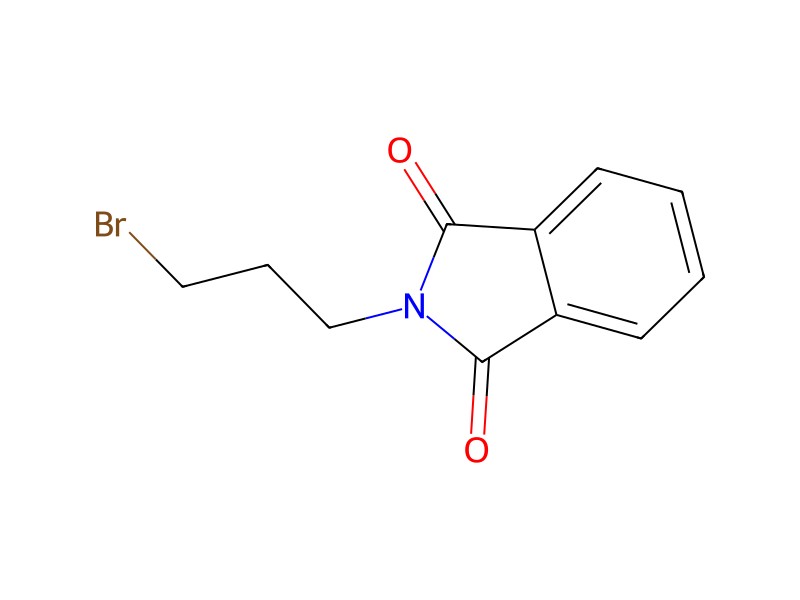
HCID 14797Potassium HydroxideHCID 21611N-3-BromopropylphthalimideHCID 24654Hydrazine hydrate (1:1)HCID 27341542,3,4,6-Tetrakis-O-(phenylmethyl)-D-galactopyranose

Product 1

HCID 697151682,3,4,6-Tetra-O-benzyl-1-O-(1-amino-prop-3-yl)-galactopyranose

Reagents, catalysts & solvents 2

HCID 94433Tetrabutylammonium hydrogen sulfateCatalyst
HCID 241BenzeneSolvent3×

Conditions

Temperature
10 °C

Procedure

A mixture that consists of 42.1 g (100 mmol) of 2,3,4,6-tetra-O-benzyl-galactopyranose, 1.7 g (5 mmol) of tetrabutylammonium hydrogen sulfate and 33.7 g (600 mmol) of fine-powder potassium hydroxide in 350 ml of benzene is cooled to 10° C. At 10° C., 40.2 g (150 mmol) of N-(3-bromopropyl)-phthalimide, dissolved in 100 ml of benzene, is added in drops over 40 minutes while being stirred vigorously. It is stirred for three hours at 10° C. 300 ml of benzene is added, solid is filtered out, and the filtrate is evaporated to the dry state in a vacuum. The filtrate residue is dissolved in 500 ml of ethanol, 25.03 ml of hydrazine hydrate (500 mmol) is added, and it is refluxed for six hours. It is allowed to cool to 0° C., deposited precipitate is filtered out, and the filtrate is evaporated to the dry state in a vacuum. The residue is dissolved in 400 ml of dichloromethane, this solution is washed twice with 5% aqueous sodium hydroxide solution, then once with water (in each case 300 ml). The organic phase is evaporated to the dry state in a vacuum, and the residue is chromatographed on silica gel (mobile solvent: dichloromethane/ethanol/triethylamine=20:2:0.1).

Workup

  1. additionis added in drops over 40 minutes
  2. stirringIt is stirred for three hours at 10° C
  3. filtrationsolid is filtered out
  4. customthe filtrate is evaporated to the dry state in a vacuum
  5. dissolutionThe filtrate residue is dissolved in 500 ml of ethanol
  6. temperatureit is refluxed for six hours
  7. temperatureto cool to 0° C.
  8. filtrationis filtered out
  9. customthe filtrate is evaporated to the dry state in a vacuum
  10. dissolutionThe residue is dissolved in 400 ml of dichloromethane
  11. washthis solution is washed twice with 5% aqueous sodium hydroxide solution
  12. customThe organic phase is evaporated to the dry state in a vacuum
  13. customthe residue is chromatographed on silica gel (mobile solvent: dichloromethane/ethanol/triethylamine=20:2:0.1)

Sources & evidence

ORD record
ord-dc3ca928298948e8aa0e25e79f8ee8bd
Source dataset
uspto-grants-2003_04
DOI
10.6084/m9.figshare.5104873.v1
Patent number
US06545135B2

Reaction notes

On this pageParticipantsConditionsProcedureWorkupSources & evidenceReaction notes