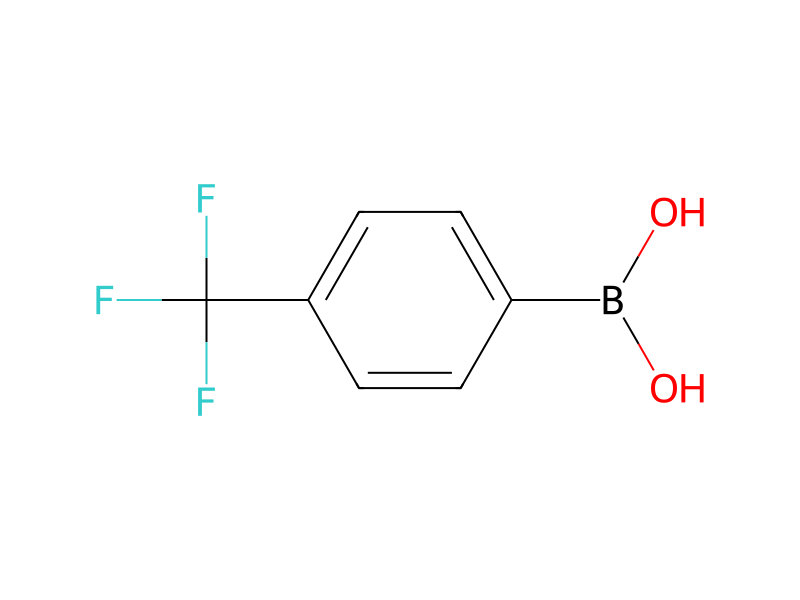
Cl[C:2]1[CH:7]=[CH:6][N:5]=[C:4]([S:8][CH3:9])[N:3]=1.C(=O)([O-])[O-].[Na+].[Na+].[F:16][C:17]([F:28])([F:27])[C:18]1[CH:23]=[CH:22][C:21](B(O)O)=[CH:20][CH:19]=1>C(COC)OC.O.[Pd].C1(P(C2C=CC=CC=2)C2C=CC=CC=2)C=CC=CC=1.C1(P(C2C=CC=CC=2)C2C=CC=CC=2)C=CC=CC=1.C1(P(C2C=CC=CC=2)C2C=CC=CC=2)C=CC=CC=1.C1(P(C2C=CC=CC=2)C2C=CC=CC=2)C=CC=CC=1>[CH3:9][S:8][C:4]1[N:3]=[C:2]([C:21]2[CH:22]=[CH:23][C:18]([C:17]([F:28])([F:27])[F:16])=[CH:19][CH:20]=2)[CH:7]=[CH:6][N:5]=1To a solution of 4-chloro-2-methylthiopyrimidine (2.17 mL, 18.7 mmol) in dimethoxyethane (140 mL) and water (70 mL) was added sodium carbonate (5.15 g, 48.5 mmol), 4-trifluoromethylphenylboronic acid and tetrakis(triphenylphosphine) palladium (0) (0.43 g). The resulting mixture was heated at reflux under nitrogen for 18 h, then allowed to cool to room temperature and the dimethoxyethane removed in vacuo. The residue was diluted with water (30 mL) and extracted CH2Cl2 (2×100 mL). The organic solution was dried (MgSO4) and the solvents removed in vacuo. Purification by Biotage™ chromatography (Silica, 90 g) eluting 19:1 cyclohexane:EtOAc yielded the title compound as a pale yellow solid (4.47 g).
Loading…