Reaction equation
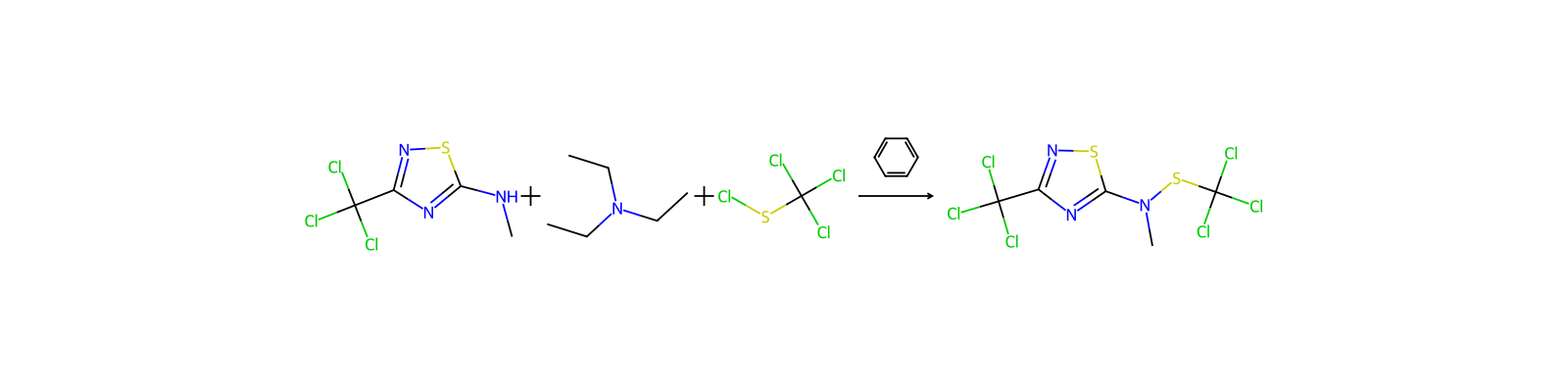
[CH3:1][NH:2][C:3]1[S:7][N:6]=[C:5]([C:8]([Cl:11])([Cl:10])[Cl:9])[N:4]=1.C(N(CC)CC)C.[Cl:19][C:20]([Cl:24])([Cl:23])[S:21]Cl>C1C=CC=CC=1>[CH3:1][N:2]([S:21][C:20]([Cl:24])([Cl:23])[Cl:19])[C:3]1[S:7][N:6]=[C:5]([C:8]([Cl:11])([Cl:9])[Cl:10])[N:4]=1Participants
5




Procedure
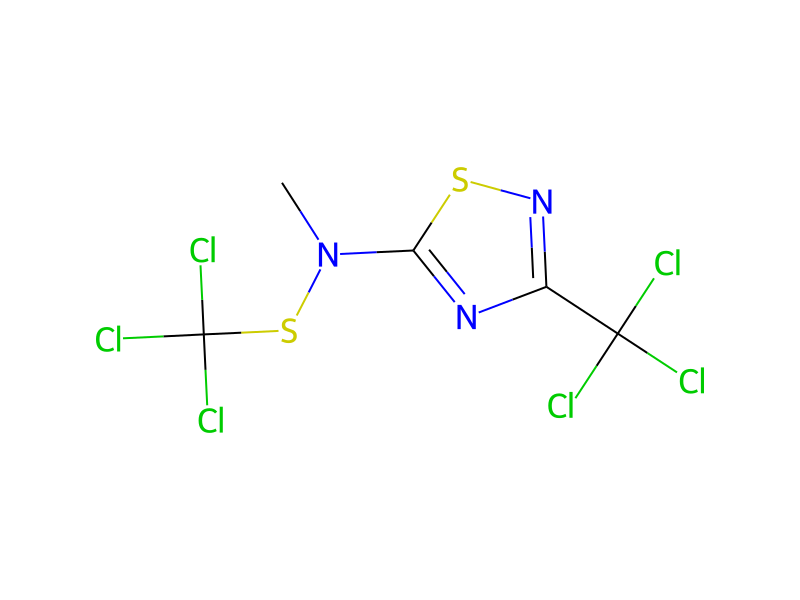
To a 3-neck flask equpped with condenser, thermometer and stirring bar was added 11.6 g (0.05 mole) 5-methylamino-3-trichloromethyl-1,2,4- thiadiazole, 5.1 g (0.05 mole) triethylamine and 150 milliliters of benzene. After 9.3 g (0.05 mole) trichloromethane-sulfenyl chloride was added, the reaction mixture was heated at reflux for 20 hours and filtered hot. The filtrate was evaporated under vacuum to give a beige solid which was refluxed in 400 milliliters of ligroin and filtered. The ligroin was cooled, filtered and the filtrate evaporated to 20 milliliters and filtered. The resulting solid was recrystallized again from ligroin to obtain 4.4 g (23% yield) of product; mp=106° C.
Workup
- customTo a 3-neck flask equpped with condenser
- temperaturethe reaction mixture was heated
- temperatureat reflux for 20 hours
- filtrationfiltered hot
- customThe filtrate was evaporated under vacuum
- customto give a beige solid which
- filtrationfiltered
- temperatureThe ligroin was cooled
- filtrationfiltered
- customthe filtrate evaporated to 20 milliliters
- filtrationfiltered
- customThe resulting solid was recrystallized again from ligroin
Sources & evidence
- ORD record
- ord-4904e7b964b44603a8858fcc6ee29db7
- Source dataset
- uspto-grants-1981_03
- Patent number
- US04254265
Linked notes
Loading…