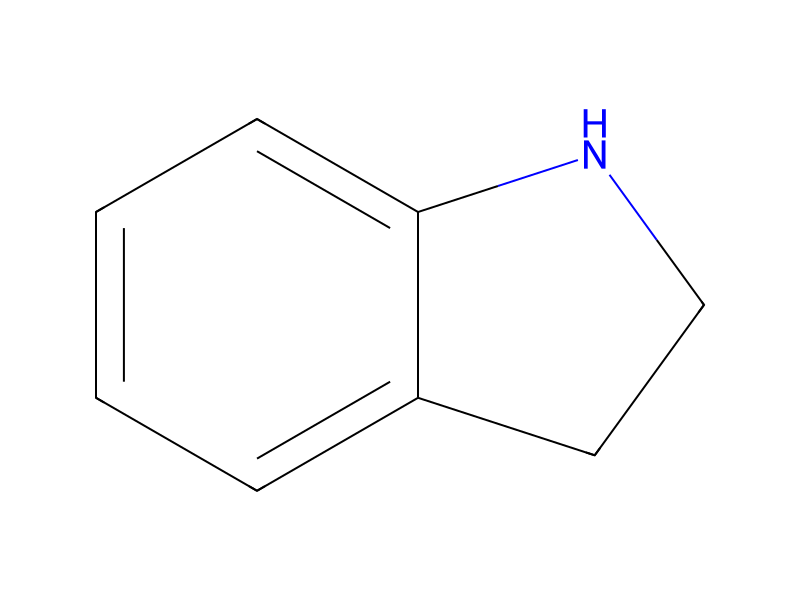
Indoline → 5,7-Dibromoindoline
HRID 1271152
Reaction equation

[NH:1]1[C:9]2[C:4](=[CH:5][CH:6]=[CH:7][CH:8]=2)[CH2:3][CH2:2]1.[Br-:10].[Br-:11].[Br-].[NH+]1C=CC=CC=1.[NH+]1C=CC=CC=1.[NH+]1C=CC=CC=1>ClCCl>[Br:10][C:6]1[CH:5]=[C:4]2[C:9](=[C:8]([Br:11])[CH:7]=1)[NH:1][CH2:2][CH2:3]2Participants
4
Reactant 2

Product 1

Reagents, catalysts & solvents 1

Procedure
Part A: Indoline (2.2 g, 18.04 mmol), dissolved in dichloromethane (160 mL) was stirred with pyridinium tribromide (12 g, 37.6 mmol) for 16 h at 25° C. The reaction was quenched with sat NaHSO3 (50 mL) and water (50 mL). The dichloromethane was separated, dried (MgSO4) and stripped in vacuo. The residue was chromatographed on silica gel using 20% ethyl acetate/hexanes as eluent to give 5,7-dibromoindoline (4.2 g, 84% yield). 1H NMR(CDCl3) δ 7.28 (m, 1H), 7.11 (s, 1H), 3.96 (s br, 1H ), 3.63 (t J=9 Hz, 1H), 3.13 (t J=9 Hz, 2H).