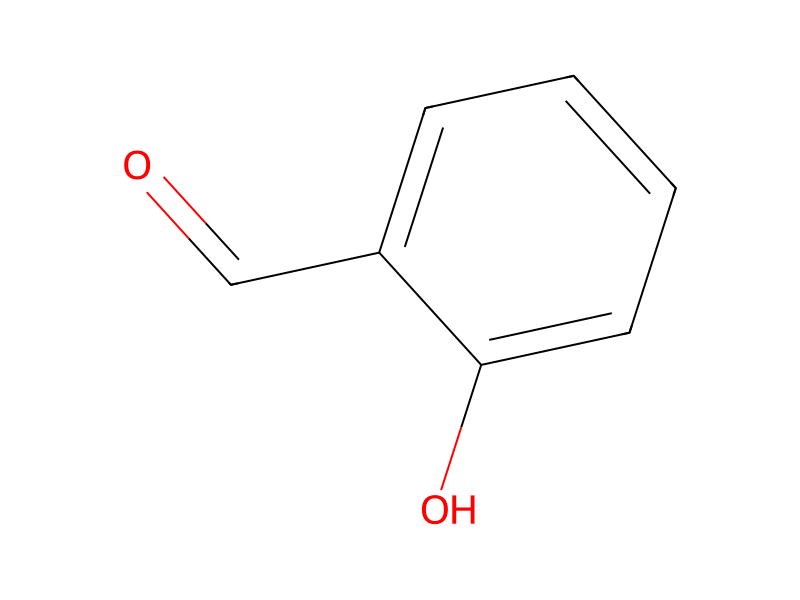
Salicylaldehyde → 2-Benzoylbenzofuran
HRID 1289027
Reaction equation

[CH:1](=O)[C:2]1[C:3](=[CH:5][CH:6]=[CH:7][CH:8]=1)[OH:4].[OH-].[K+].[CH2:12](Cl)[C:13]([C:15]1[CH:20]=[CH:19][CH:18]=[CH:17][CH:16]=1)=[O:14]>C(O)C>[C:13]([C:12]1[O:4][C:3]2[CH:5]=[CH:6][CH:7]=[CH:8][C:2]=2[CH:1]=1)(=[O:14])[C:15]1[CH:20]=[CH:19][CH:18]=[CH:17][CH:16]=1Participants
5
Reactant 3


Product 1

Reagents, catalysts & solvents 1

Procedure
24.4 g of salicylaldehyde and 300 ml of ethanol are mixed with 11.6 g of potassium hydroxide. The resulting suspension is agitated at room temperature until the potassium hydroxide is completely dissolved. Subsequently, 31 g of phenacyl chloride are added in portions to the solution, and the batch is heated under stirring in a reflux condenser for 2 hours. The crystals precipitated while cooling down to room temperature are filtered by suction, washed with water, and recrystallized from methanol. Another fraction may be obtained by evaporating the mother liquor. Yield: 70%, colourless crystals.