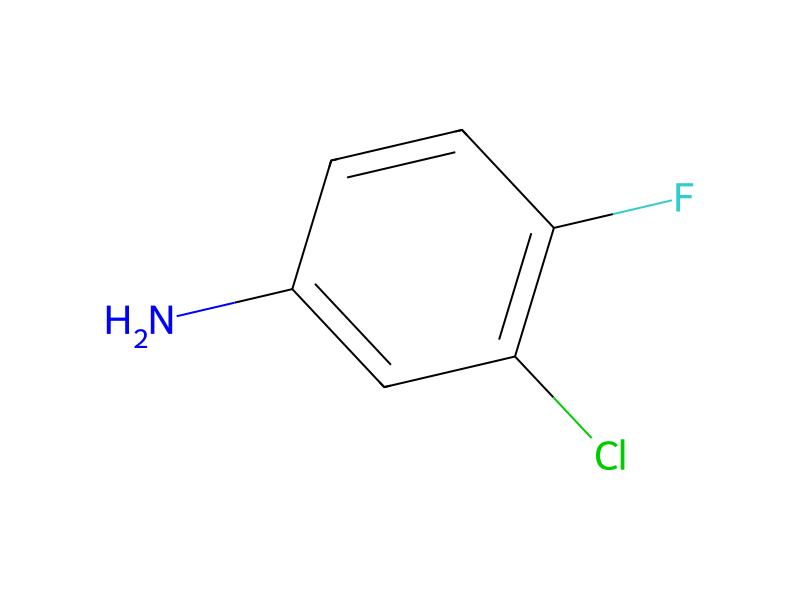
A stirred solution of 6.1 grams (42 mmole) of 3-chloro-4-fluoroaniline, 5.0 grams (42 mmole) of 2-methoxy-2-methylpropanoic acid, and 10.5 grams (55 mmole) of 1-(3-dimethylaminopropyl)-3-ethylcarbodiimide hydrochloride in 120 mL of methylene chloride was cooled to about 0° C., and 7.4 grams (55 mmole) of 1-hydroxybenzotriazole was added. Upon completion of the addition the reaction was slowly warmed to ambient temperature, where it stirred for about 18 hours. After this time the reaction mixture was poured into water, and the resulting mixture was filtered through diatomaceous earth to remove any salts that had precipitated. The organic layer was separated from the aqueous layer, washed with an aqueous saturated sodium chloride solution, dried with sodium sulfate, and filtered. The filtrate was concentrated under reduced pressure to a brown oil, which was passed through a silica gel scrub plug, yielding 5.0 grams of N-(3-chloro-4-fluorophenyl)-2-methoxy-2-methylpropionamide. The NMR spectrum was consistent with the proposed structure.