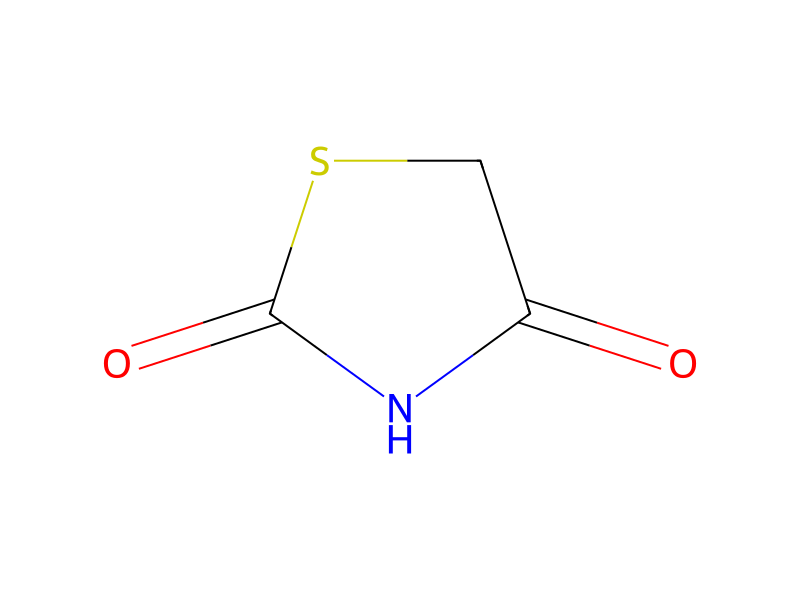
Thiazolidinedione → 5-(3,4-Dibromobenzylidene)thiazolidine-2,4-dione
Reaction equation

[S:1]1[CH2:5][C:4](=[O:6])[NH:3][C:2]1=[O:7].[Br:8][C:9]1[CH:10]=[C:11]([CH:14]=[CH:15][C:16]=1[Br:17])[CH:12]=O.N1CCCCC1>C(O)(=O)C>[Br:8][C:9]1[CH:10]=[C:11]([CH:14]=[CH:15][C:16]=1[Br:17])[CH:12]=[C:5]1[S:1][C:2](=[O:7])[NH:3][C:4]1=[O:6]Participants
5
Reactant 3


Product 1

Reagents, catalysts & solvents 1

Procedure
A mixture of thiazolidine-2,4-dione (90%, 65 mg, 0.5 mmol), 3,4-dibromobenzaldehyde (132 mg, 0.5 mmol), and piperidine (247 μL, 2.5 mmol) was shaken in acetic acid (2 mL) at 110° C. for 16 hours. After cooling, the mixture was concentrated to dryness in vacuo. The resulting crude product was shaken with water, centrifuged, and the supernatant was discarded. Subsequently the residue was shaken with ethanol, centrifuged, the supernatant was discarded and the residue was further evaporated to dryness to afford the title compound.
Workup
- temperatureAfter cooling
- concentrationthe mixture was concentrated to dryness in vacuo
- stirringSubsequently the residue was shaken with ethanol
- customthe residue was further evaporated to dryness
Sources & evidence
- ORD record
- ord-1368f77cd1ce4057b5c4f1e0728b3996
- Source dataset
- uspto-grants-2011_02
- Patent number
- US07879893B2
Reaction notes
Loading…