Reaction equation
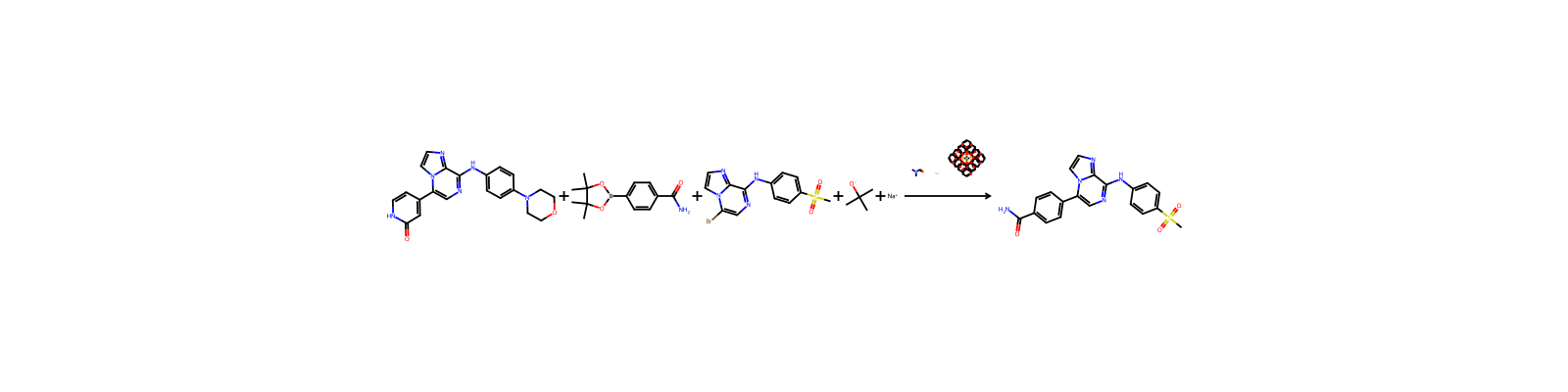
N1(C2C=CC(NC3C4N(C=CN=4)C(C4C=CNC(=O)C=4)=CN=3)=CC=2)CCOCC1.CC1(C)C(C)(C)OB([C:38]2[CH:46]=[CH:45][C:41]([C:42]([NH2:44])=[O:43])=[CH:40][CH:39]=2)O1.Br[C:49]1[N:54]2[CH:55]=[CH:56][N:57]=[C:53]2[C:52]([NH:58][C:59]2[CH:64]=[CH:63][C:62]([S:65]([CH3:68])(=[O:67])=[O:66])=[CH:61][CH:60]=2)=[N:51][CH:50]=1.CC([O-])(C)C.[Na+]>CN(C=O)C.O.C1C=CC([P]([Pd]([P](C2C=CC=CC=2)(C2C=CC=CC=2)C2C=CC=CC=2)([P](C2C=CC=CC=2)(C2C=CC=CC=2)C2C=CC=CC=2)[P](C2C=CC=CC=2)(C2C=CC=CC=2)C2C=CC=CC=2)(C2C=CC=CC=2)C2C=CC=CC=2)=CC=1>[CH3:68][S:65]([C:62]1[CH:63]=[CH:64][C:59]([NH:58][C:52]2[C:53]3[N:54]([CH:55]=[CH:56][N:57]=3)[C:49]([C:38]3[CH:39]=[CH:40][C:41]([C:42]([NH2:44])=[O:43])=[CH:45][CH:46]=3)=[CH:50][N:51]=2)=[CH:60][CH:61]=1)(=[O:66])=[O:67]Participants
Reactant 4




Product 1

Reagents, catalysts & solvents 3



Procedure
In the same way as described for Compound 85, step 1, using 4-(4,4,5,5-tetramethyl-[1,3,2]dioxaborolan-2-yl)-benzamide (1.0 g, 6.11 mmol), (5-bromo-imidazo[1,2-a]pyrazin-8-yl)-(4-methanesulfonyl-phenyl)-amine (1.49 g, 4.07 mmol), Pd(PPh3)4 (471 mg, 0.41 mmol) and NaOtBu (1.57 g, 0.82 mmol) in DMF (18 mL) and water (6 mL). The residue is chromatographed on silica gel, eluting with DCM followed by 95:5 DCM:NH3 (7M in MeOH), and the fractions containing the desired product are combined and evaporated to afford a solid, crystallised in ethyl acetate (566 mg, 34%). LCMS: Rt 2.53 min (99%), m/z (APCI) 408 (M+H)+; 1H-NMR (400 MHz, d6-DMSO δ(ppm) 3.21 (3H, s), 7.54 (1H, br s), 7.67 (1H, s), 7.81 (1H, s), 7.86-7.92 (4H, m), 8.09-8.17 (3H, m), 8.21 (1H, br s), 8.41 (2H, d), 10.32 (1H, s).
Workup
- customThe residue is chromatographed on silica gel
- washeluting with DCM
- additionNH3 (7M in MeOH), and the fractions containing the desired product
- customevaporated
- customto afford a solid
- customcrystallised in ethyl acetate (566 mg, 34%)
Sources & evidence
- ORD record
- ord-851af5bc762143cd9f6b29238e7a6800
- Source dataset
- uspto-grants-2011_02
- Patent number
- US07893058B2
Linked notes
Loading…