HomeMCPWorkbenchSkills
HomeWorkbenchNotificationsMe
llms.txt · MCP GuidePrivacy Policy · Terms of Service · Supportv1.8.3
  1. Home
  2. /Reaction

Sodium Hydroxide → 7-Fluoro-3-(2-fluoro-4-iodo-phenylamino)-thieno[3,2-c]pyridine-2-carboxylic acid (2-vinyloxy-ethoxy)-amide

HRID 1366793
Print

Reaction equation

HRID 1366793 reaction equation
C(O[C:4]([C:6]1[S:14][C:13]2[C:12]([F:15])=[CH:11][N:10]=[CH:9][C:8]=2[C:7]=1[NH:16][C:17]1[CH:22]=[CH:21][C:20]([I:23])=[CH:19][C:18]=1[F:24])=[O:5])C.[OH-].[Na+].[CH:27]([O:29][CH2:30][CH2:31][O:32][NH2:33])=[CH2:28].CCN=C=NCCCN(C)C.C1C=CC2N(O)N=NC=2C=1>>[CH:27]([O:29][CH2:30][CH2:31][O:32][NH:33][C:4]([C:6]1[S:14][C:13]2[C:12]([F:15])=[CH:11][N:10]=[CH:9][C:8]=2[C:7]=1[NH:16][C:17]1[CH:22]=[CH:21][C:20]([I:23])=[CH:19][C:18]=1[F:24])=[O:5])=[CH2:28]

ParticipantsConditionsProcedureWorkupSources & evidenceReaction notes

Participants

6

Reactant 5

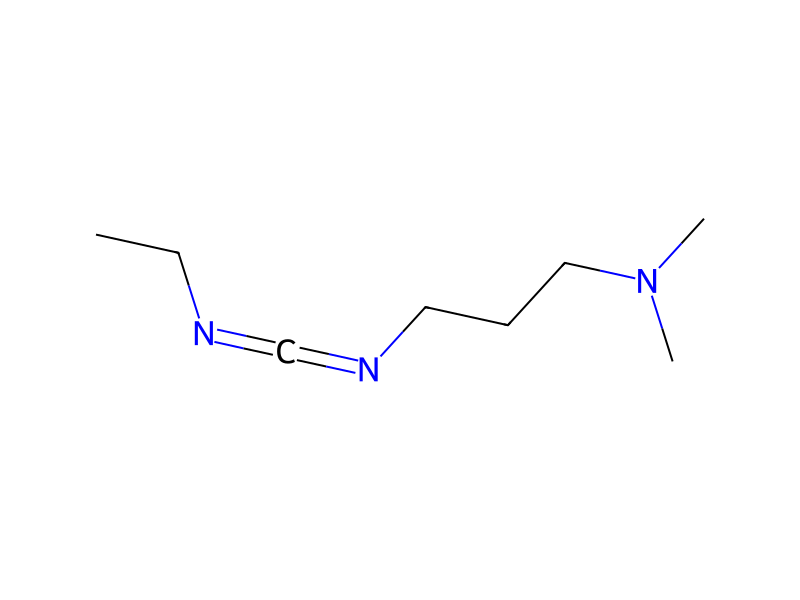
HCID 14798Sodium HydroxideHCID 159081-Ethyl-3-(3'-dimethylaminopropyl)carbodiimideHCID 757711-HydroxybenzotriazoleHCID 21867017O-(2-(Vinyloxy)ethyl)hydroxylamineHCID 597039117-Fluoro-3-(2-fluoro-4-iodo-phenylamino)-thieno[3,2-c]pyridine-2-carboxylic acid ethyl ester

Product 1

HCID 59703872
7-Fluoro-3-(2-fluoro-4-iodo-phenylamino)-thieno[3,2-c]pyridine-2-carboxylic acid (2-vinyloxy-ethoxy)-amide
Yield 54%

Conditions

Temperature
65 °C

Procedure

To a solution 7-fluoro-3-(2-fluoro-4-iodo-phenylamino)-thieno[3,2-c]pyridine-2-carboxylic acid ethyl ester (175 mg, 0.38 mmol) in IMS (4 mL) was added a 1.0 M aqueous solution of sodium hydroxide (0.5 mL, 0.5 mmol). The reaction mixture was heated to 65° C. for 1 hour before being cooled to room temperature and concentrated in vacuo. The resulting residue was azeotroped with toluene (3×10 mL), and then suspended in THF (5 mL). O-(2-Vinyloxy-ethyl)-hydroxylamine (78 mg, 0.76 mmol), N—N-diisopropylethylamine (0.26 mL, 1.52 mmol), EDCI (146 mg, 0.76 mmol), and HOBt (103 mg, 0.76 mmol) were then added sequentially, and the reaction mixture stirred for 18 hours at room temperature. The reaction mixture was concentrated in vacuo and the residue was partitioned between water and ethyl acetate. The organic layer was separated and washed with a saturated solution of sodium hydrogenocarbonate and brine, dried over sodium sulfate, filtered and concentrated to give a residue, which was purified by column chromatography (Si-SPE, gradient 0-2% methanol in DCM) to afford the title compound as a pale yellow solid (106 mg, 54%). LCMS (method B): RT=3.92 min. M+H+=518.

Workup

  1. temperaturebefore being cooled to room temperature
  2. concentrationconcentrated in vacuo
  3. customThe resulting residue was azeotroped with toluene (3×10 mL)
  4. concentrationThe reaction mixture was concentrated in vacuo
  5. customthe residue was partitioned between water and ethyl acetate
  6. customThe organic layer was separated
  7. washwashed with a saturated solution of sodium hydrogenocarbonate and brine
  8. dry with materialdried over sodium sulfate
  9. filtrationfiltered
  10. concentrationconcentrated
  11. customto give a residue, which
  12. customwas purified by column chromatography (Si-SPE, gradient 0-2% methanol in DCM)

Sources & evidence

ORD record
ord-7f417a673d4245a7b90f1e40dff7ec1c
Source dataset
uspto-grants-2011_02
DOI
10.6084/m9.figshare.5104873.v1
Patent number
US07893085B2

Reaction notes

On this pageParticipantsConditionsProcedureWorkupSources & evidenceReaction notes
