Reaction equation

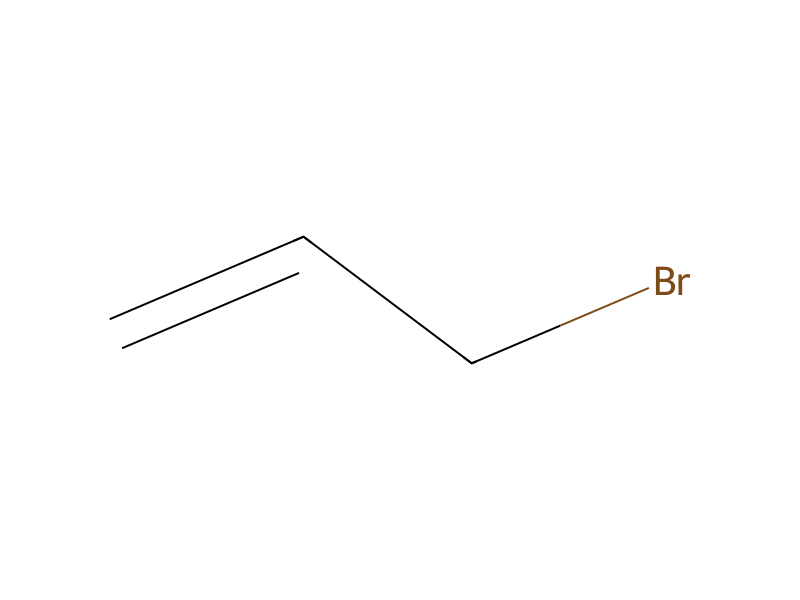
[Br:1][C:2]1[CH:7]=[C:6]([CH3:8])[CH:5]=[C:4]([N+:9]([O-:11])=[O:10])[C:3]=1[OH:12].C([O-])([O-])=O.[K+].[K+].[CH2:19](Br)[CH:20]=[CH2:21]>CC(C)=O>[CH2:21]([O:12][C:3]1[C:4]([N+:9]([O-:11])=[O:10])=[CH:5][C:6]([CH3:8])=[CH:7][C:2]=1[Br:1])[CH:20]=[CH2:19]Participants
5
Reactant 3


Product 1

Reagents, catalysts & solvents 1

Procedure
To a mixture of 2-bromo-4-methyl-6-nitrophenol (7.00 g, 30.2 mmol), K2CO3 (6.26 g, 45.3 mmol) in acetone (105 mL) was added allyl bromide (3.80 ml, 45.3 mmol). The reaction mixture was stirred at room temperature overnight. It was then heated at 40° C. for 5 hrs. Inorganic salts were filtered and washed with acetone. The filtrate was concentrated to give 7.74 g (94%) of the desired product. MS (DCI/NH3) m/z: 289.0 (M+NH4)+; 1H NMR (300 MHz, CD3OD) δ ppm 2.37 (s, 3 H) 4.61 (d, J=6.10 Hz, 2 H) 5.26 (dd, J=10.51, 1.80 Hz, 1 H) 5.39 (dd, J=17.29, 1.80 Hz, 1 H) 6.09 (m, 1 H) 7.63 (s, 1 H) 7.74 (s, 1 H).
Workup
- temperatureIt was then heated at 40° C. for 5 hrs
- filtrationInorganic salts were filtered
- washwashed with acetone
- concentrationThe filtrate was concentrated
Sources & evidence
- ORD record
- ord-45249ef8d80d45258c2767c58c8dce87
- Source dataset
- uspto-grants-2007_01
- Patent number
- US07163939B2
Linked notes
Loading…