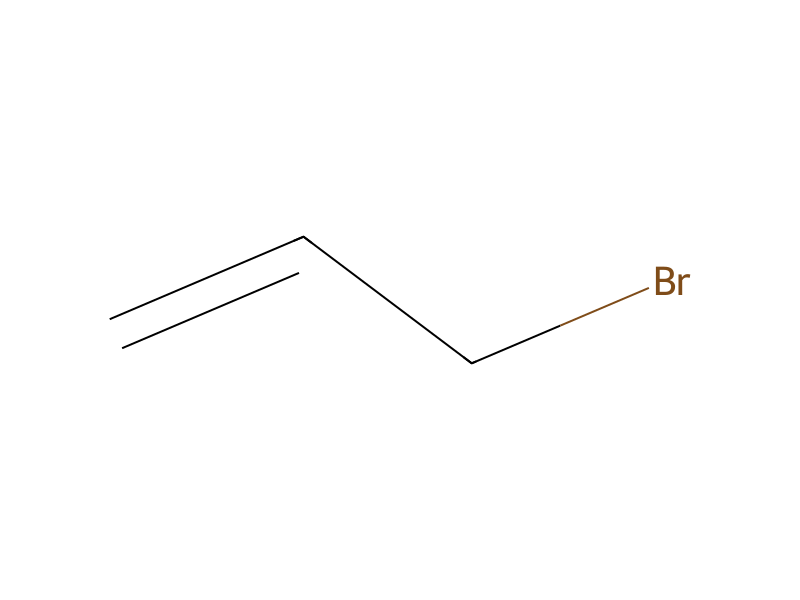
[CH2:1](Br)[CH:2]=[CH2:3].[F:5][C:6]1[C:7](=[O:19])[O:8][C:9]2[C:14]([C:15]=1[CH3:16])=[CH:13][CH:12]=[C:11]([OH:17])[C:10]=2[CH3:18].C(=O)([O-])[O-].[K+].[K+]>CC(C)=O>[F:5][C:6]1[C:7](=[O:19])[O:8][C:9]2[C:14]([C:15]=1[CH3:16])=[CH:13][CH:12]=[C:11]([O:17][CH2:3][CH:2]=[CH2:1])[C:10]=2[CH3:18]Allyl bromide (1.08 mL, 12.48 mmoles) was added to a mixture of 3-fluoro-4,8-dimethyl-7-hydroxycoumarin (1.73 g, 8.31 mmoles), ca. 5 g of potassium carbonate and 45 mL of dry acetone. The reaction mixture was stirred under an inert atmosphere at room temperature for 28 hours. During this time, excess allyl bromide (1.44 mL, 16.64 mmoles) was added in two portions. The carbonate salt was removed by suction filtration washed with acetone and the solvent evaporated under reduced pressure yielding a solid, which was purified by recrystallisation from a mixture of methanol:water. Thus, 1.60 g (78% yield) of 3-fluoro-4,8-dimethyl-7-allyloxycoumarin was obtained as a white solid: mp 117° C.