Reaction equation

[Cl:1][C:2]1[CH:7]=[CH:6][C:5]([CH2:8][C:9]([C:11]2[CH:16]=[CH:15][C:14]([Cl:17])=[CH:13][C:12]=2[Cl:18])=[O:10])=[CH:4][CH:3]=1.C1C=C[NH+]=CC=1.[O-:25][Cr](Cl)(=O)=O.N1C=CC=CC=1>ClCCCl>[Cl:1][C:2]1[CH:7]=[CH:6][C:5]([C:8](=[O:25])[C:9]([C:11]2[CH:16]=[CH:15][C:14]([Cl:17])=[CH:13][C:12]=2[Cl:18])=[O:10])=[CH:4][CH:3]=1Participants
5

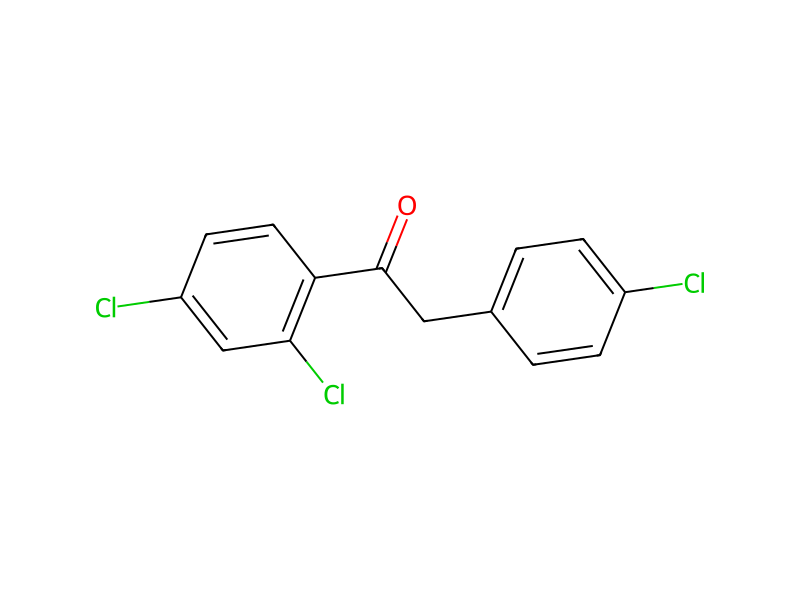



Conditions
- Temperature
- 25 °C
Procedure
2-(4-Chlorophenyl)-1-(2,4-dichlorophenyl)ethanone (2.7 g, 9.01 mmol) was dissolved in 1,2-dichloroethane (25 ml) and freshly made PCC (3.89 g, 18.02 mmol), pyridine (1.43 g, 18.02 mmol) and molecular sieves were added. The reaction mixture was refluxed under inert atmosphere overnight. The solution was cooled to 25° C., filtered through Silica and then solvent was evaporated under reduced pressure. The crude product (1.9 g, 66%) was used directly in the next step. 1H NMR (500 MHz) δ 7.97 (d, 2H), 7.84 (d, 1H), 7.52 (d, 2H), 7.46 (s, 1H), 7.44 (d, 1H).
Workup
- temperatureThe reaction mixture was refluxed under inert atmosphere overnight
- filtrationfiltered through Silica
- customsolvent was evaporated under reduced pressure
Sources & evidence
- ORD record
- ord-3cbb9601a1ed43258aaa8f322aa5f853
- Source dataset
- uspto-grants-2008_03
- Patent number
- US07342019B2
Linked notes
Loading…