HomeMCPSkillsWorkbenchOpenChem
HomeWorkbenchNotificationsMe
llms.txt · skill.md · MCP GuidePrivacy Policy · Terms of Service · Supportv1.8.4
  1. Home
  2. /Reaction

Potassium Phosphate, Tribasic → 4-Fluoro-2-(2-nitro-5-(piperidin-1-yl)phenyl)pyridine

HRID 1408130
Print

Reaction equation

[N+:1]([C:4]1[CH:9]=[CH:8][C:7]([N:10]2[CH2:15][CH2:14][CH2:13][CH2:12][CH2:11]2)=[CH:6][C:5]=1B1OC(C)(C)C(C)(C)O1)([O-:3])=[O:2].Cl[C:26]1[CH:31]=[C:30]([F:32])[CH:29]=[CH:28][N:27]=1.[O-]P([O-])([O-])=O.[K+].[K+].[K+].C1(P(C2CCCCC2)C2C=CC=CC=2C2C(OC)=CC=CC=2OC)CCCCC1>COCCOC.O.C1C=CC([P]([Pd]([P](C2C=CC=CC=2)(C2C=CC=CC=2)C2C=CC=CC=2)([P](C2C=CC=CC=2)(C2C=CC=CC=2)C2C=CC=CC=2)[P](C2C=CC=CC=2)(C2C=CC=CC=2)C2C=CC=CC=2)(C2C=CC=CC=2)C2C=CC=CC=2)=CC=1>[F:32][C:30]1[CH:29]=[CH:28][N:27]=[C:26]([C:5]2[CH:6]=[C:7]([N:10]3[CH2:11][CH2:12][CH2:13][CH2:14][CH2:15]3)[CH:8]=[CH:9][C:4]=2[N+:1]([O-:3])=[O:2])[CH:31]=1
ParticipantsConditionsProcedureWorkupSources & evidenceReaction notes

Participants

7

Reactant 4

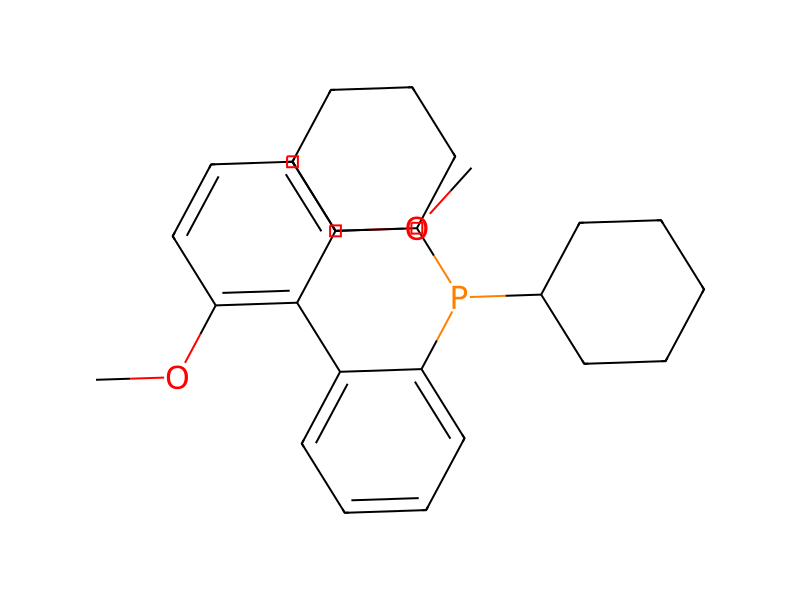
HCID 62657Potassium Phosphate, TribasicHCID 27827922-Chloro-4-fluoropyridineHCID 112698722-Dicyclohexylphosphino-2',6'-dimethoxybiphenylHCID 665874871-[4-Nitro-3-(4,4,5,5-tetramethyl-[1,3,2]dioxaborolan-2-yl)-phenyl]-piperidine

Product 1

HCID 665867694-Fluoro-2-(2-nitro-5-(piperidin-1-yl)phenyl)pyridine
Yield 58.8%

Reagents, catalysts & solvents 2

HCID 178418397HCID 178418397, compoundCatalystHCID 18180031Water 1,2-dimethoxyethaneSolvent

Conditions

Temperature
80 °C

Procedure

Into a 500-mL 3-necked round bottom flask purged and maintained with an inert atmosphere of nitrogen, was placed a solution of 1-(4-nitro-3-(4,4,5,5-tetramethyl-1,3,2-dioxaborolan-2-yl)phenyl) piperidine (15 g, 45.18 mmol, 1.00 equiv) in DME/H2O (100/5 mL), 2-chloro-4-fluoropyridine (7.80 g, 60.00 mmol, 1.20 equiv), K3PO4 (31 g, 146.23 mmol, 3.00 equiv), 2-dicyclohexylphosphino-2′,6′-dimethoxybiphenyl (SPhos) (2.00 g, 4.88 mmol, 0.10 equiv), and Pd(PPh3)4 (2800 mg, 2.42 mmol, 0.05 equiv). The resulting solution was stirred for 1 overnight at 80° C. in an oil bath. The reaction progress was monitored by LCMS. The resulting mixture was concentrated under vacuum. The resulting solution was diluted with 200 mL of H2O, extracted with 3×300 mL of dichloromethane, and the organic layers combined. The resulting mixture was washed with 1×20 mL of brine, dried over anhydrous sodium sulfate, and concentrated under vacuum. The residue was applied onto a silica gel column and eluted with ethyl acetate/petroleum ether (10:1). The product was obtained as 8 g of a yellow solid.

Workup

  1. customInto a 500-mL 3-necked round bottom flask purged
  2. temperaturemaintained with an inert atmosphere of nitrogen
  3. concentrationThe resulting mixture was concentrated under vacuum
  4. additionThe resulting solution was diluted with 200 mL of H2O
  5. extractionextracted with 3×300 mL of dichloromethane
  6. washThe resulting mixture was washed with 1×20 mL of brine
  7. dry with materialdried over anhydrous sodium sulfate
  8. concentrationconcentrated under vacuum
  9. washeluted with ethyl acetate/petroleum ether (10:1)

Sources & evidence

ORD record
ord-80a75935ec624e7c906e7ed2afbec845
Source dataset
uspto-grants-2014_12
DOI
10.6084/m9.figshare.5104873.v1
Patent number
US08916569B2

Reaction notes

On this pageParticipantsConditionsProcedureWorkupSources & evidenceReaction notes