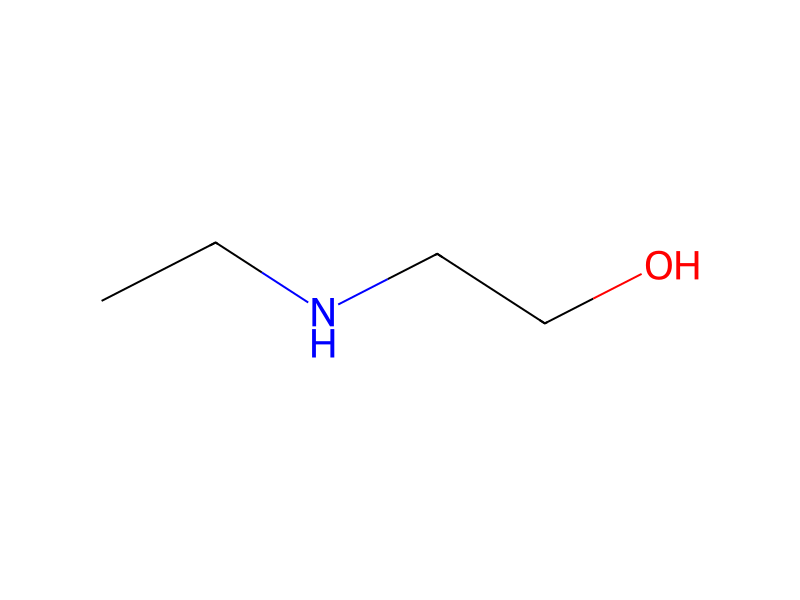
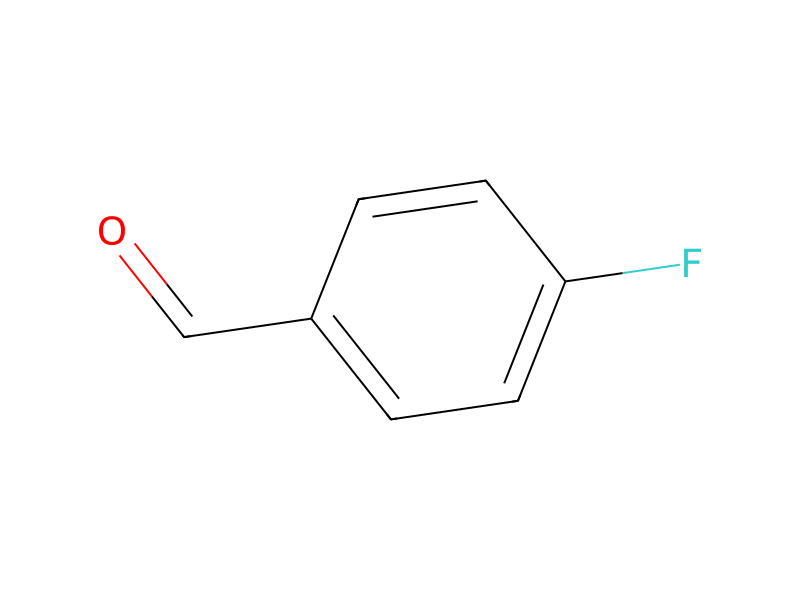
A one liter three-neck flask, fitted with mechanical stirrer, thermometer, and condenser, was charged with 25 g (0.2 mol) of 4-fluorobenzaldehyde), 54 g (0.6 mol) of 2-(ethylamino)ethanol, 41.5 g (0.3 mol) of anhydrous potassium carbonate, and 0.5 ml ALIQUAT-336™ (tricaprylyl methylammonium chloride) (Henkel Corp.) in 250 ml dimethylsulfoxide ("DMSO"). The reaction mixture was heated at 95° C. for 72 hours, cooled to room temperature, and then poured into an ice water mixture. The water layer was extracted with dichloromethane, and the combined organics were washed twice with cold water. After solvent evaporation, the red-colored oil was dissolved in 200 ml of ether and poured into 800 ml of 1N aqueous HCl. After stirring for 10 minutes, the water layer was separated and neutralized using aqueous sodium carbonate. 200 ml dichloromethane were added, and the organic layer was separated and dried with anhydrous sodium sulfate. Removal of the solvent afforded 4-(N-ethyl-N-hydroxyethylamino)benzaldehyde as a pale yellow oil. Yield 25 g (65%); 1H-NMR (CDCl3) δ1.18 (t, 3H), 2.30 (s, 1H), 3.62 (m, 2H), 3.66 (t, 2H), 3.90 (t, 2H), 6.70 (d, 2H), 7.68 (d, 2H), 9.62 (s, 1H) ppm.