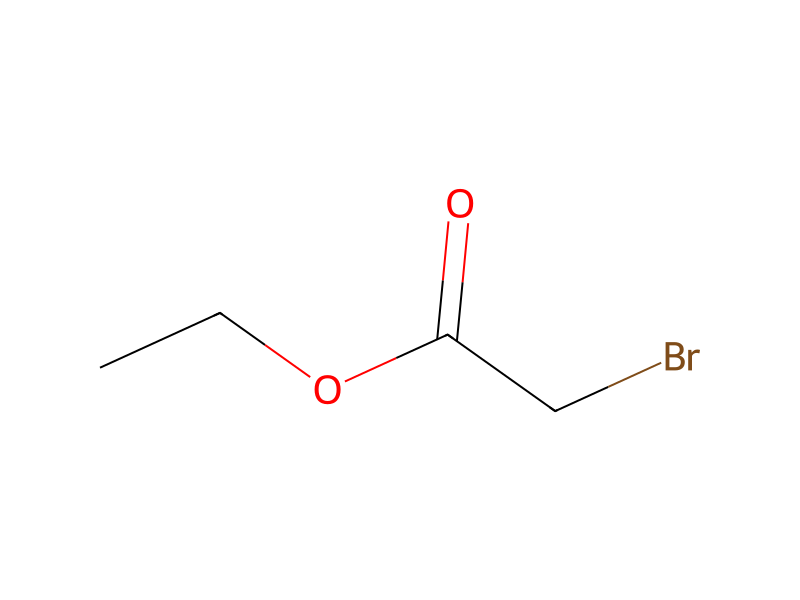
Ethyl bromoacetate → Ethyl [(3,5-dichloro-6-fluoropyridin-2-yl)oxy]acetate
HRID 1448405
Reaction equation

[Na].[Cl:2][C:3]1[C:4]([OH:11])=[N:5][C:6]([F:10])=[C:7]([Cl:9])[CH:8]=1.Br[CH2:13][C:14]([O:16][CH2:17][CH3:18])=[O:15]>C(O)C>[CH2:17]([O:16][C:14](=[O:15])[CH2:13][O:11][C:4]1[C:3]([Cl:2])=[CH:8][C:7]([Cl:9])=[C:6]([F:10])[N:5]=1)[CH3:18]Participants
5
Reactant 3


Product 1

Reagents, catalysts & solvents 1

Procedure
A solution was prepared by dissolving 6.9 grams (0.3 mole) of sodium metal in 700 milliliters of 95 percent ethanol. To this solution was added with stirring 54.5 grams (0.3 mole) of 3,5-dichloro-6-fluoro-2-pyridinol. Thereafter 58.5 grams (0.35 mole) of ethyl bromoacetate was added and the mixture refluxed for 5 hours. At the completion of the reaction, the ethanol was distilled off and the residue poured into water. The solid which precipitated was filtered off and taken up in hexane and dried with activated carbon and anhydrous sodium sulfate. The mixture was filtered and the hexane removed and the ethyl-(3,5-dichloro-6-fluoro-2-pyridyloxy) acetate product was recovered by distillation. The product was a white waxy solid which boiled at 135°-170° C. (M.P. 63.5°-64° C.)