Reaction equation
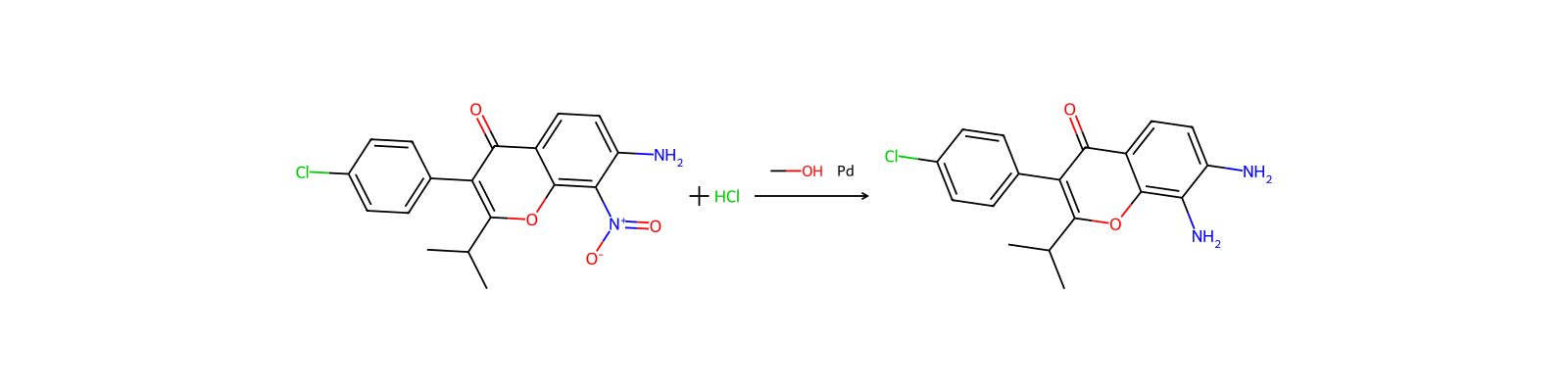
[NH2:1][C:2]1[C:11]([N+:12]([O-])=O)=[C:10]2[C:5]([C:6](=[O:25])[C:7]([C:18]3[CH:23]=[CH:22][C:21]([Cl:24])=[CH:20][CH:19]=3)=[C:8]([CH:15]([CH3:17])[CH3:16])[O:9]2)=[CH:4][CH:3]=1.Cl>CO.[Pd]>[NH2:1][C:2]1[C:11]([NH2:12])=[C:10]2[C:5]([C:6](=[O:25])[C:7]([C:18]3[CH:19]=[CH:20][C:21]([Cl:24])=[CH:22][CH:23]=3)=[C:8]([CH:15]([CH3:16])[CH3:17])[O:9]2)=[CH:4][CH:3]=1Participants
5





Procedure
7-Amino-3-(4-chlorophenyl)-2-isopropyl-8-nitro-chromen-4-one (450 mg, 0.94 mmol) is suspended in methanol (5 ml). Concentrated hydrochloric acid (5 ml) is added. The mixture is placed under an atmosphere of argon, and 10% palladium on activated carbon (50 mg) is added. The reaction mixture is placed under an atmosphere of hydrogen and stirred at room temperature for 24 h. The mixture is filtered through a Celite pad, and the Celite pad is washed with methanol (3×30 ml). The filtrate and the washings are combined and evaporated to give a yellow solid.
Workup
- filtrationThe mixture is filtered through a Celite pad
- washthe Celite pad is washed with methanol (3×30 ml)
- customevaporated
- customto give a yellow solid
Sources & evidence
- ORD record
- ord-0189d225b5614d789f5d04eee4b24eaf
- Source dataset
- uspto-grants-2010_06
- Patent number
- US07732435B2
Linked notes
Loading…