Benzyl Alcohol → Benzyl [8-(2,4,5-trifluorophenyl)-1,4-dioxaspiro[4,5]dec-7-yl]carbamate
HRID 1454792
Reaction equation
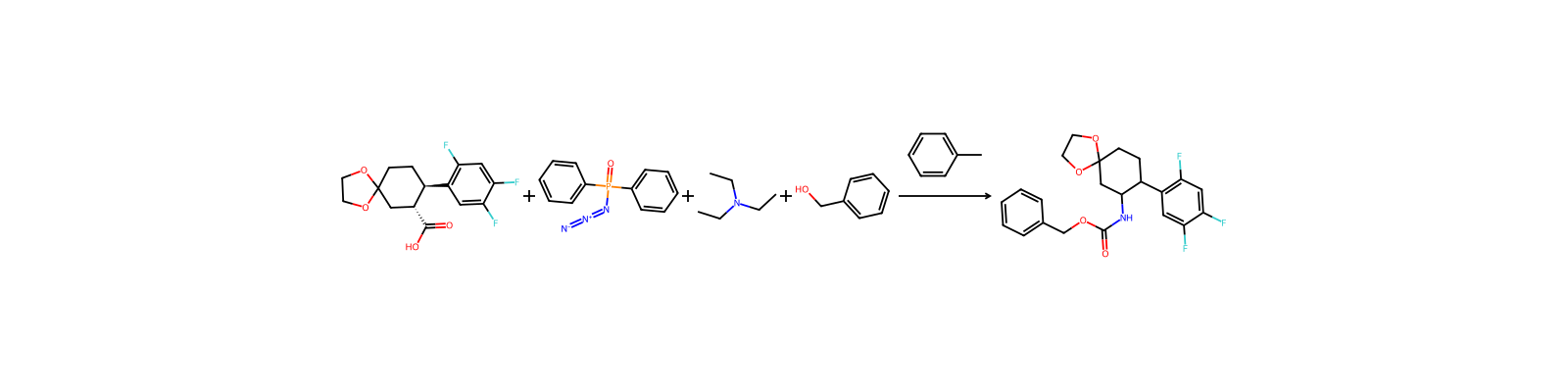
[F:1][C:2]1[CH:7]=[C:6]([F:8])[C:5]([F:9])=[CH:4][C:3]=1[C@@H:10]1[CH2:19][CH2:18][C:13]2([O:17][CH2:16][CH2:15][O:14]2)[CH2:12][C@H:11]1C(O)=O.C1(P(N=[N+]=[N-])(C2C=CC=CC=2)=[O:30])C=CC=CC=1.C([N:42]([CH2:45]C)CC)C.[CH2:47]([OH:54])[C:48]1[CH:53]=[CH:52][CH:51]=[CH:50][CH:49]=1>C1(C)C=CC=CC=1>[F:1][C:2]1[CH:7]=[C:6]([F:8])[C:5]([F:9])=[CH:4][C:3]=1[CH:10]1[CH2:19][CH2:18][C:13]2([O:14][CH2:15][CH2:16][O:17]2)[CH2:12][CH:11]1[NH:42][C:45](=[O:30])[O:54][CH2:47][C:48]1[CH:53]=[CH:52][CH:51]=[CH:50][CH:49]=1Participants
6
Reactant 4




Product 1

Reagents, catalysts & solvents 1
