Nitric Acid → 4-Bromo-8-nitroisoquinoline
HRID 1454935
Reaction equation

[N+:1]([O-:4])(O)=[O:2].[Br:5][C:6]1[C:15]2[C:10](=[CH:11][CH:12]=[CH:13][CH:14]=2)[CH:9]=[N:8][CH:7]=1>OS(O)(=O)=O.O>[Br:5][C:6]1[C:15]2[C:10](=[C:11]([N+:1]([O-:4])=[O:2])[CH:12]=[CH:13][CH:14]=2)[CH:9]=[N:8][CH:7]=1Participants
5
Reactant 2

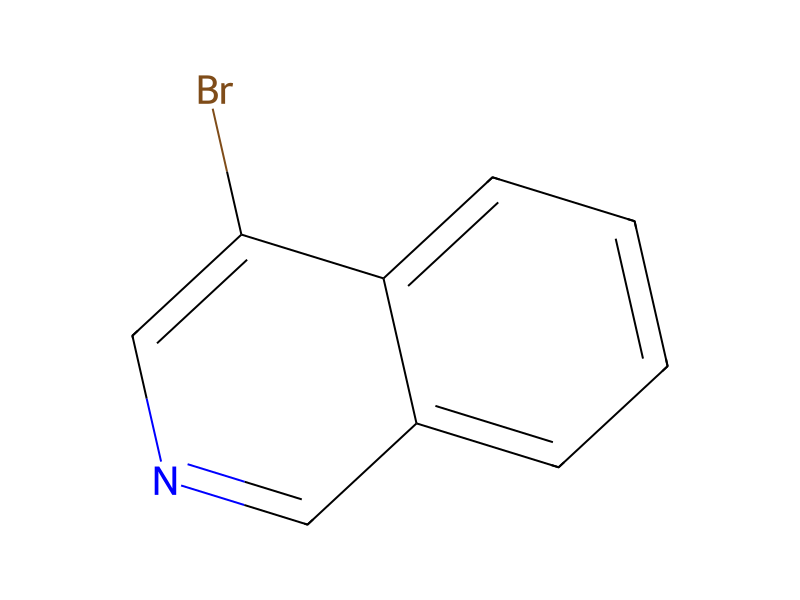
Product 1

Reagents, catalysts & solvents 2


Procedure
Under argon, at room temperature, 65% HNO3 (200 mmol, 13.85 ml) is added in small portions to a solution of 4-bromoisoquinoline (100 mmol, 21.24 g) in 36N H2SO4 (50 ml). The reaction mixture is stirred for 3 h at room temperature. It is cooled to 0° C. and is then diluted with water. A yellow precipitate forms. It is filtered. The pH of the filtrate is adjusted to pH 10 by slow addition of 5N NaOH. The white precipitate which appears is extracted with CH2Cl2. This organic solution is washed with brine, dried over Na2SO4 and then evaporated under vacuum. The residue is purified by eluting on silica gel with an AcOEt/petroleum ether mixture. The purified product is recrystallized from absolute ethanol (EtOH).