Sorbitol → Phenylpropanolamine hydrochloride Sorbitol
HRID 1461225
Reaction equation

[OH:1][CH2:2][C@@H:3]([C@H:5]([C@@H:7]([C@@H:9]([CH2:11][OH:12])[OH:10])[OH:8])[OH:6])[OH:4].[CH3:13][CH:14]([NH2:23])[CH:15]([OH:22])[C:16]1[CH:17]=[CH:18][CH:19]=[CH:20][CH:21]=1.[ClH:24]>O>[CH3:13][CH:14]([NH2:23])[CH:15]([OH:22])[C:16]1[CH:17]=[CH:18][CH:19]=[CH:20][CH:21]=1.[ClH:24].[OH:12][CH2:11][C@@H:9]([C@H:7]([C@@H:5]([C@@H:3]([CH2:2][OH:1])[OH:4])[OH:6])[OH:8])[OH:10]Participants
4
Reactant 2
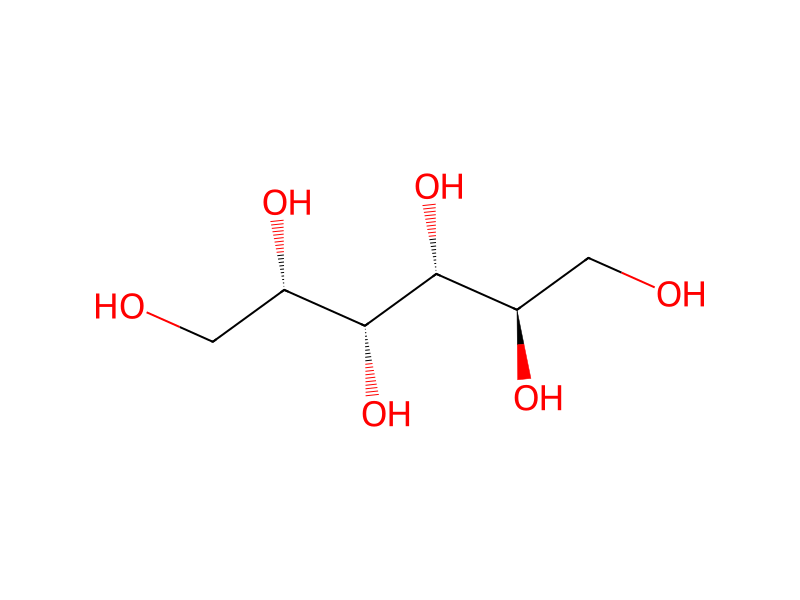

Product 1

Reagents, catalysts & solvents 1

Procedure
Once thoroughly dispersed, the molten sorbitol melt containing uniformly dispersed particles of phenylpropanolamine hydrochloride was placed in a jacketed agitator equipped with double Sigma blades and slowly cooled to 90° C. with a steam/water mix flowing through the jacket and maintaining constant agitation, until the molten magma was crystallized to a viscous mass. At this point, such viscous mass was transferred to trays and held in an oven at 90° C. for 4 hours until it was fully crystallized. Lumps of this fully crystallized material were ground in a Waring blender and screened through a set of stainless steel screens collecting the material passing through the 40 mesh (U.S. Sieve Series) screen and held on a 100 mesh screen (-40/+100 cut). The resultant powder was assayed and was found to contain 3.8% phenylpropanolamine hydrochloride.