Reaction equation

C1(N)C(F)=C(F)C(F)=C(N)C=1F.Cl.Cl.[F:15][C:16]1[CH:17]=[C:18]([N:28]2[CH2:32][CH:31]([CH2:33][NH2:34])[O:30][C:29]2=[O:35])[CH:19]=[CH:20][C:21]=1[N:22]1[CH2:27][CH2:26][O:25][CH2:24][CH2:23]1.C(N(CC)CC)C.[C:43](OC(=O)C)(=[O:45])[CH3:44]>ClCCl>[F:15][C:16]1[CH:17]=[C:18]([N:28]2[CH2:32][CH:31]([CH2:33][NH:34][C:43](=[O:45])[CH3:44])[O:30][C:29]2=[O:35])[CH:19]=[CH:20][C:21]=1[N:22]1[CH2:23][CH2:24][O:25][CH2:26][CH2:27]1Participants




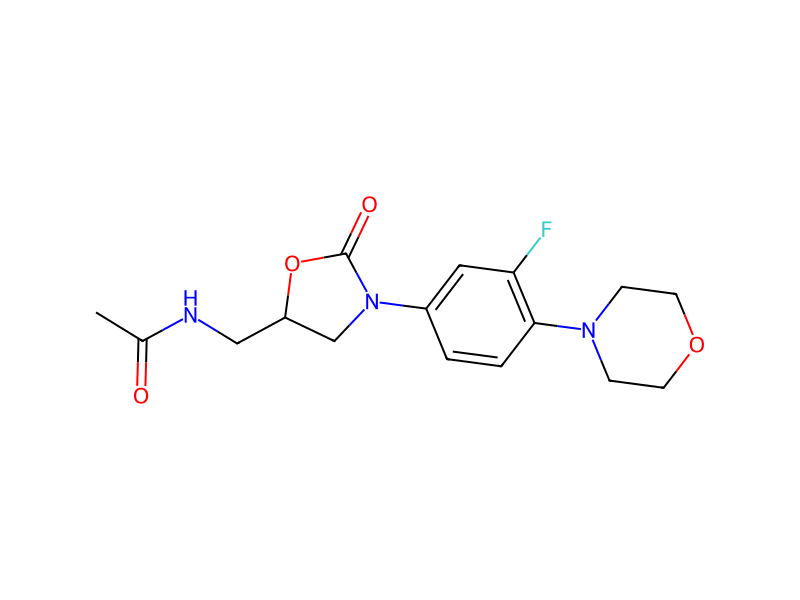

Procedure
To a reaction flask were added 6.53 mmol of dihydrochloride of 3-(3-fluoro-4-morpholinylphenyl-5-aminomethyl-1,3-oxazolidin-2-one (5a), 100 ml of dichloromethane and 2.95 ml (21.2 mmol) of triethylamine. Then 0.8 ml (8.45 mmol) of acetic anhydride was added while being stirred in an ice-bath. The mixture was then allowed to react at room temperature for 2 hours before being washed successively with 5% aqueous NaOH solution and saturated aqueous NaCl solution. The organic layer was then dried by anhydrous sodium sulfate and filtered, and subsequently put under reduced pressure for solvent removal. The residue was then subjected to recrystallization using ethyl acetate to give white needle crystals at a yield of 85%, HR-TOF-MS (+Q) m/z: 338.1520 (Calculated [C16H20FN3O4+H]+: 338.1516).
Workup
- customto react at room temperature for 2 hours
- washbefore being washed successively with 5% aqueous NaOH solution and saturated aqueous NaCl solution
- dry with materialThe organic layer was then dried by anhydrous sodium sulfate
- filtrationfiltered
- customsubsequently put under reduced pressure for solvent removal
- customThe residue was then subjected to recrystallization
- customto give white needle crystals at a yield of 85%, HR-TOF-MS (+Q) m/z
Sources & evidence
- ORD record
- ord-105550dc7a56445f8ca6182f96d8c40a
- Source dataset
- uspto-grants-2015_04
- Patent number
- US09012631B2
Linked notes
Loading…