HomeMCPWorkbenchSkills
HomeWorkbenchNotificationsMe
llms.txt · MCP GuidePrivacy Policy · Terms of Service · Supportv1.8.3
  1. Home
  2. /Reaction

1,4-Dibromobenzene → 2-(2,5-Dibromophenyl)-4,4,5,5-tetramethyl-1,3,2-dioxaborolane

HRID 1490569
Print

Reaction equation

HRID 1490569 reaction equation
Brc1ccc(Br)cc1>C1=CCCC=CCC1.C1=CCCC=CCC1.CC1(C)OB(B2OC(C)(C)C(C)(C)O2)OC1(C)C.COC1CCCC1.C[OH2+].C[OH2+].[Ir].[Ir].c1ccc(N2B(B3Nc4ccccc4N3c3ccccn3)Nc3ccccc32)nc1>CC1(C)OB(c2cc(Br)ccc2Br)OC1(C)C
ParticipantsConditionsProcedureSources & evidenceReaction notes

Participants

6

Reactant 1

HCID 78041,4-Dibromobenzene

Product 1

HCID 707006522-(2,5-Dibromophenyl)-4,4,5,5-tetramethyl-1,3,2-dioxaborolaneYield 62%

Reagents, catalysts & solvents 4

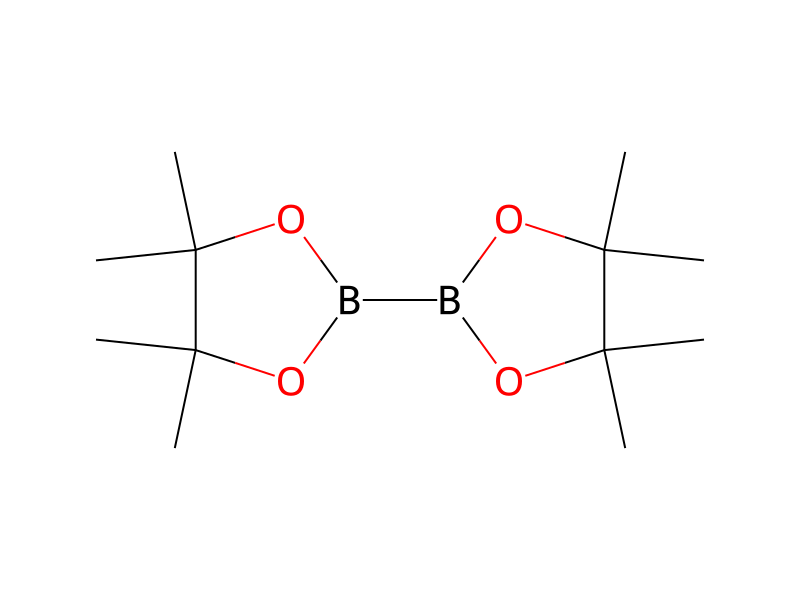
HCID 2733548Bis(pinacolato)diboraneReagentHCID 1223807993-pyridin-2-yl-2-(3-pyridin-2-yl-1H-1,3,2-benzodiazaborol-2-yl)-1H-1,3,2-benzodiazaboroleReagent
HCID 76001521
Bis(1,5-cyclooctadiene)dimethoxydiiridium
Catalyst
HCID 138539Cyclopentyl methyl etherSolvent

Conditions

Temperature
100 °C

Procedure

The general procedure A was followed using 1,4-dibromobenzene (118.0 mg, 0.5 mmol) and B2pin2 (126.9 mg, 0.5 mmol, 1.0 eq.) as starting material. The resulting mixture was allowed to stir 16 hours at 100 oC. The 1H NMR conversion was 90% and the byproducts were 2,6-di- and 2,5-di- borylated products. The 1H NMR yields of 5ac, 2,6-di- and 2,5-di- borylated products were 67%, 12% and 12% respectively. 5ac was obtained as white solid (112.0 mg, 62%) after purification by silica gel flash chromatography (EtOAc/PE=1:100 v/v). m.p.: 54-56 oC.

Sources & evidence

ORD record
ord-066c508c5a254808b5bb566fd4b02a47
Source dataset
Borylation dataset from Roche
DOI
10.1021/jacs.5b05252

Reaction notes

On this pageParticipantsConditionsProcedureSources & evidenceReaction notes