Reaction equation

[O:1]=[P:2]12[O:13]P3(OP(OP(O3)(O1)=O)(=O)O2)=O.[F:15][P-](F)(F)(F)(F)F.[CH2:22]([N+:26]1[CH:30]=[CH:29][N:28]([CH3:31])[CH:27]=1)[CH2:23][CH2:24][CH3:25].C(=O)(OC)OC.[FH:38]>>[P:2]([F:15])([F:38])([O-:13])=[O:1].[CH2:22]([N+:26]1[CH:30]=[CH:29][N:28]([CH3:31])[CH:27]=1)[CH2:23][CH2:24][CH3:25]Participants
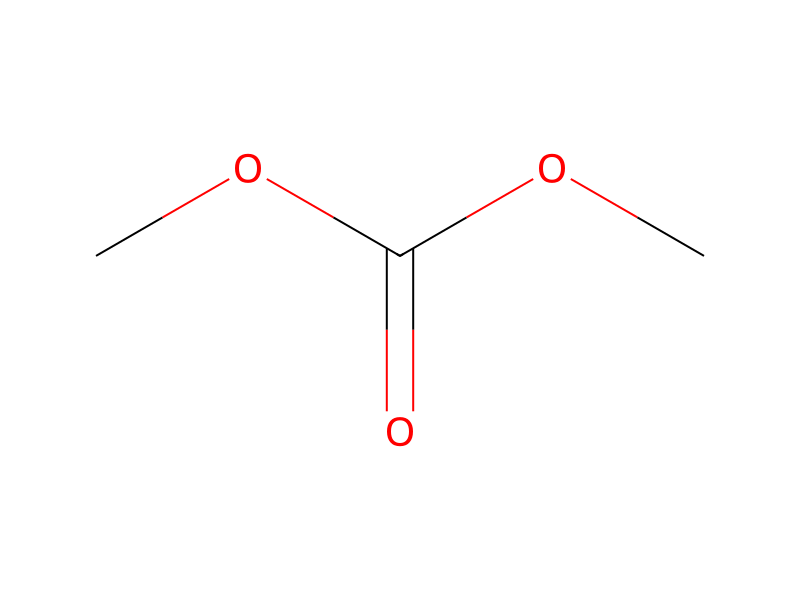


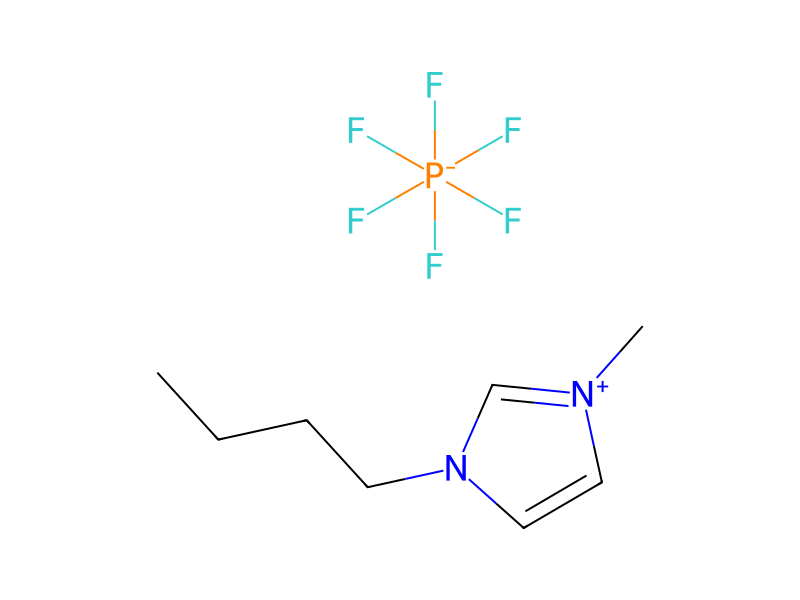
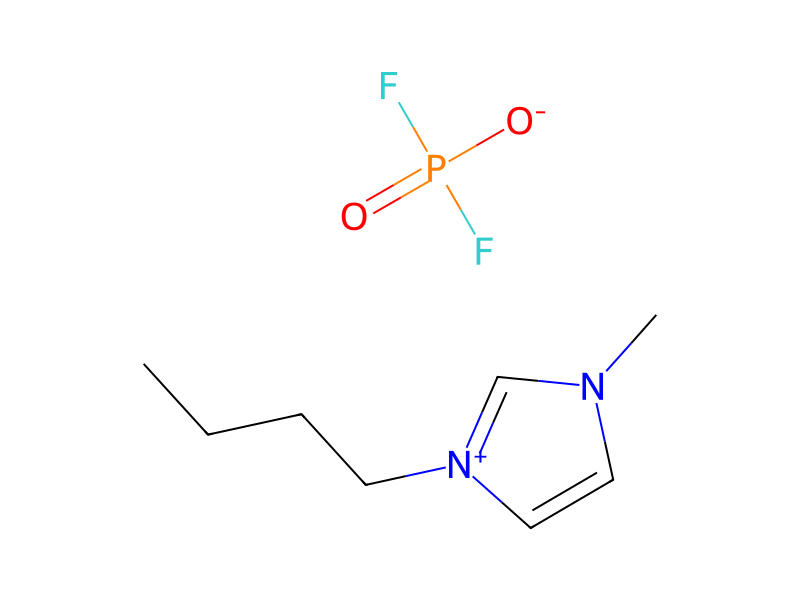
Conditions
- Temperature
- 110 °C
Procedure
Diphosphorus pentoxide (reagent, produced by Wako Pure Chemical Industries, Ltd.) (2.8 g) was weighed into a 250 ml-volume PFA vessel, and 5.7 g of 1-butyl-3-methylimidazolium hexafluorophosphate (reagent, produced by Wako Pure Chemical Industries, Ltd.) was added. Subsequently, 14.0 g of a dimethyl carbonate solution of 10% hydrogen fluoride was added, and the mixture was refluxed at 110° C. for 1 hour while flowing nitrogen. Thereafter, the reaction solution was heated at 130° C. for 17 hours, thereby distilling off the excess solvent and reaction by-products, and then cooled to room temperature to obtain 1-butyl-3-methylimidazolium difluorophosphate. Anion analysis was performed in the same manner as in Example 1-1, as a result, the purity of the obtained 1-butyl-3-methylimidazolium difluorophosphate was 92% in terms of the relative area.
Workup
- additionwas added
- temperatureThereafter, the reaction solution was heated at 130° C. for 17 hours
- distillationdistilling off
- customthe excess solvent and reaction by-products
- temperaturecooled to room temperature
Sources & evidence
- ORD record
- ord-9c0a981776064bd68a44f248fb129416
- Source dataset
- uspto-grants-2015_12
- Patent number
- US09203106B2
Linked notes
Loading…