Reaction equation

[Cl:1][C:2]1[C:7](C(O)=O)=[CH:6][C:5]([F:11])=[C:4]([O:12][CH3:13])[N:3]=1.C1(P([N:28]=[N+]=[N-])(C2C=CC=CC=2)=O)C=CC=CC=1.[C:31](=[O:34])(O)[O-:32].[Na+].[C:36]1([CH3:42])[CH:41]=CC=C[CH:37]=1.C(N(CC)CC)C.C(O)(C)(C)C>>[Cl:1][C:2]1[C:7]([NH:28][C:31](=[O:34])[O:32][C:36]([CH3:42])([CH3:41])[CH3:37])=[CH:6][C:5]([F:11])=[C:4]([O:12][CH3:13])[N:3]=1Participants
5




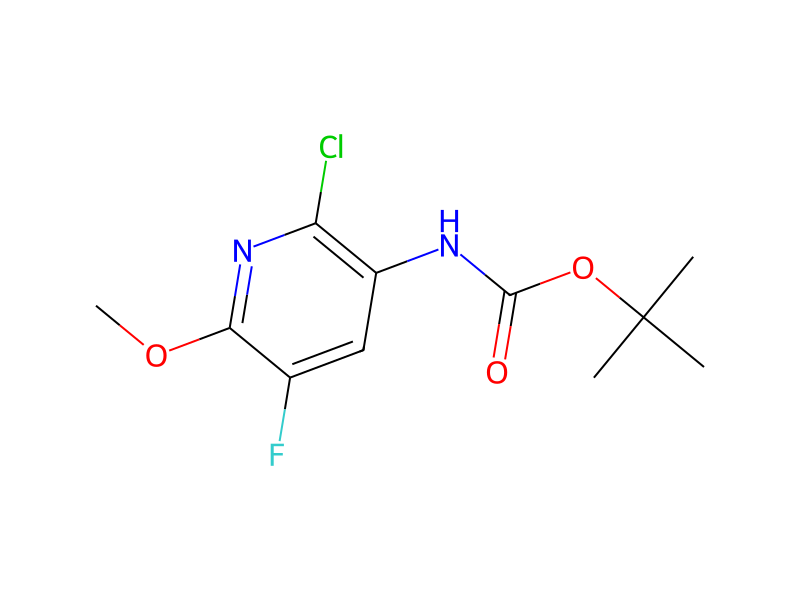
Conditions
- Temperature
- 100 °C
Procedure
A mixture of 2-chloro-5-fluoro-6-(methyloxy)-3-pyridinecarboxylic acid (32.65 g, 159 mmol) in toluene/triethylamine/tert-butanol (300 ml/26.4 ml/75 ml) was treated with diphenylphosphoryl azide (37.7 ml, 174.8 mmol) and heated to 100° C. for 2 hours. The mixture was treated with saturated aqueous sodium bicarbonate solution (500 ml) then extracted with ethyl acetate (3×500 ml). The combined organic extracts were dried over magnesium sulphate and evaporated. The residue was chromatographed eluting with 0-40% dichloromethane in petrol affording the product as a white solid (36.35 g, 83%).
Workup
- extractionthen extracted with ethyl acetate (3×500 ml)
- dry with materialThe combined organic extracts were dried over magnesium sulphate
- customevaporated
- customThe residue was chromatographed
- washeluting with 0-40% dichloromethane in petrol affording the product as a white solid (36.35 g, 83%)
Sources & evidence
- ORD record
- ord-186390d6ffe74cdbb70148554e5003f6
- Source dataset
- uspto-grants-2010_06
- Patent number
- US07732460B2
Linked notes
Loading…