HomeMCPSkillsWorkbenchOpenChem
HomeWorkbenchNotificationsMe
llms.txt · skill.md · MCP GuidePrivacy Policy · Terms of Service · Supportv1.8.6
  1. Home
  2. /Reaction

Potassium Carbonate → Methyl 2-(4-cyclopropyl-3-oxo-1-oxa-4,9-diazaspiro[5.5]undecan-9-yl)-2-(2-fluoro-4-(quinolin-7-yl)phenyl)acetate

HRID 1525902
Print

Reaction equation

Br[C:2]1[CH:7]=[CH:6][C:5]([CH:8]([N:13]2[CH2:27][CH2:26][C:16]3([O:21][CH2:20][C:19](=[O:22])[N:18]([CH:23]4[CH2:25][CH2:24]4)[CH2:17]3)[CH2:15][CH2:14]2)[C:9]([O:11][CH3:12])=[O:10])=[C:4]([F:28])[CH:3]=1.CC1(C)C(C)(C)OB([C:37]2[CH:46]=[C:45]3[C:40]([CH:41]=[CH:42][CH:43]=[N:44]3)=[CH:39][CH:38]=2)O1.C(=O)([O-])[O-].[K+].[K+]>O1CCOCC1.C1C=CC(P(C2C=CC=CC=2)[C-]2C=CC=C2)=CC=1.C1C=CC(P(C2C=CC=CC=2)[C-]2C=CC=C2)=CC=1.Cl[Pd]Cl.[Fe+2].C(Cl)Cl>[CH:23]1([N:18]2[CH2:17][C:16]3([CH2:26][CH2:27][N:13]([CH:8]([C:5]4[CH:6]=[CH:7][C:2]([C:37]5[CH:46]=[C:45]6[C:40]([CH:41]=[CH:42][CH:43]=[N:44]6)=[CH:39][CH:38]=5)=[CH:3][C:4]=4[F:28])[C:9]([O:11][CH3:12])=[O:10])[CH2:14][CH2:15]3)[O:21][CH2:20][C:19]2=[O:22])[CH2:25][CH2:24]1
ParticipantsProcedureWorkupSources & evidenceReaction notes

Participants

6

Reactant 3

HCID 11430Potassium CarbonateHCID 592961167-(4,4,5,5-tetramethyl-1,3,2-dioxaborolan-2-yl)QuinolineHCID 71270944Methyl 2-(4-bromo-2-fluorophenyl)-2-(4-cyclopropyl-3-oxo-1-oxa-4,9-diazaspiro[5.5]undecan-9-yl)acetate

Product 1

HCID 71270934Methyl 2-(4-cyclopropyl-3-oxo-1-oxa-4,9-diazaspiro[5.5]undecan-9-yl)-2-(2-fluoro-4-(quinolin-7-yl)phenyl)acetate

Reagents, catalysts & solvents 2

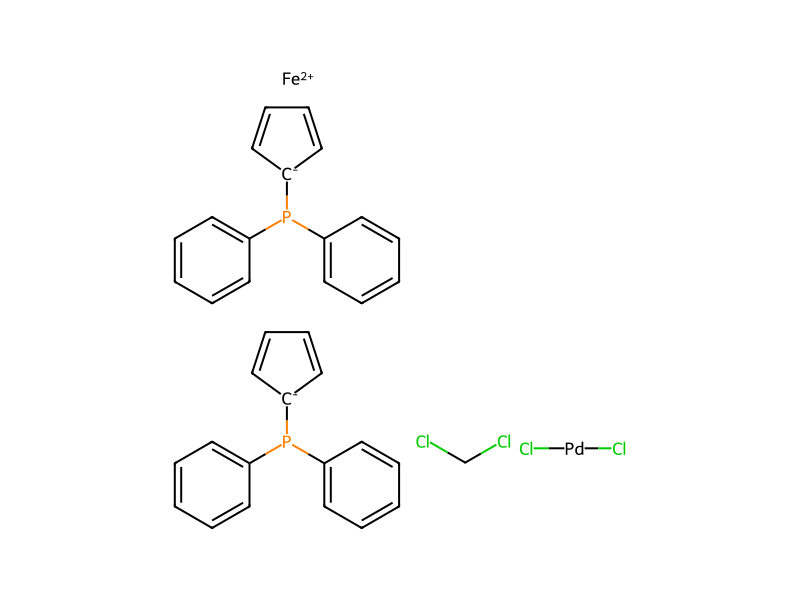
HCID 178418807HCID 178418807, compoundCatalyst
HCID 312751,4-DioxaneSolvent

Procedure

A solution of methyl 2-(4-bromo-2-fluorophenyl)-2-(4-cyclopropyl-3-oxo-1-oxa-4,9-diazaspiro[5.5]undecan-9-yl)acetate (2.53 mmol) in 1,4-dioxane (8 mL) was treated with 7-(4,4,5,5-tetramethyl-1,3,2-dioxaborolan-2-yl)quinoline (2.78 mmol), PdCl2(dppf)-CH2Cl2 adduct (0.126 mmol), and 2M aq potassium carbonate (7.58 mmol). The reaction vessel was purged with nitrogen and sealed, and the mixture irradiated in a Biotage Initiator Microwave at 120° C. for 15 min. The resulting black mixture was diluted with water (100 mL) and brine (20 mL) and was extracted three times with ethyl acetate. The combined organic layers were washed with brine, dried over sodium sulfate, filtered and concentrated in vacuo. Purification of the residue by silica gel chromatography (0-5% methanol/dichloromethane) afforded the desired product, which was dissolved with dichloromethane and concentrated in vacuo three times to afford the title compound as a brown gel (1.21 grams, 81% yield). MS(ES)+ m/e 504.1 [M+H]+.

Workup

  1. customThe reaction vessel was purged with nitrogen
  2. customsealed
  3. customthe mixture irradiated in a Biotage Initiator Microwave at 120° C. for 15 min
  4. additionThe resulting black mixture was diluted with water (100 mL) and brine (20 mL)
  5. extractionwas extracted three times with ethyl acetate
  6. washThe combined organic layers were washed with brine
  7. dry with materialdried over sodium sulfate
  8. filtrationfiltered
  9. concentrationconcentrated in vacuo
  10. customPurification of the residue by silica gel chromatography (0-5% methanol/dichloromethane)

Sources & evidence

ORD record
ord-73e472a0710d4df390ad22ba3891510f
Source dataset
uspto-grants-2015_07
DOI
10.6084/m9.figshare.5104873.v1
Patent number
US09084794B2

Reaction notes

On this pageParticipantsProcedureWorkupSources & evidenceReaction notes