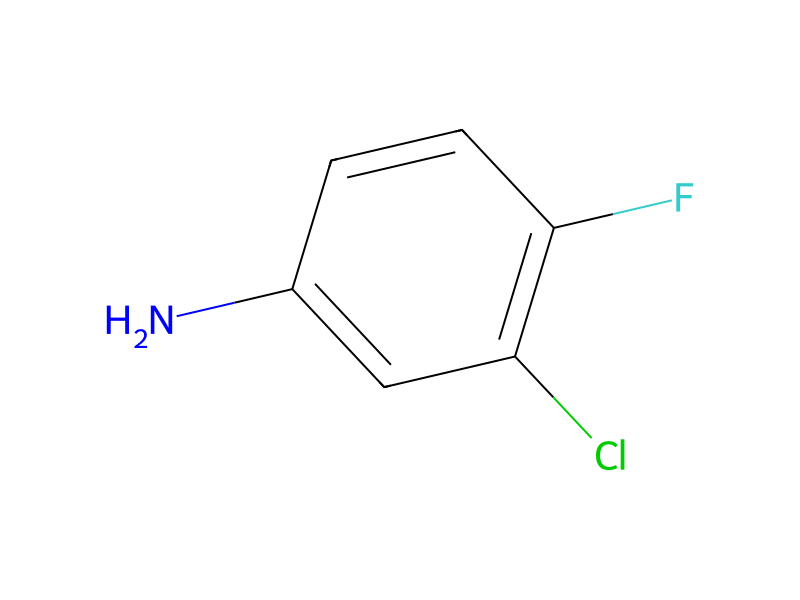
3-Chloro-4-fluoroaniline → (3-Chloro-4-fluorophenyl)-5,6,7,8-tetrahydrobenzo[1,2-b]pyrimidino[5,6-d]selenophen-4-ylamine
HRID 1529815
Reaction equation

Cl[C:2]1[C:7]2[C:8]3[CH2:14][CH2:13][CH2:12][CH2:11][C:9]=3[Se:10][C:6]=2[N:5]=[CH:4][N:3]=1.[Cl:15][C:16]1[CH:17]=[C:18]([CH:20]=[CH:21][C:22]=1[F:23])[NH2:19]>C(O)(C)C>[Cl:15][C:16]1[CH:17]=[C:18]([NH:19][C:2]2[C:7]3[C:8]4[CH2:14][CH2:13][CH2:12][CH2:11][C:9]=4[Se:10][C:6]=3[N:5]=[CH:4][N:3]=2)[CH:20]=[CH:21][C:22]=1[F:23]Participants
4
Reactant 2

Product 1

Reagents, catalysts & solvents 1

Procedure
To a solution of step b compound (300 mg, 1.10 mmol) in isopropyl alcohol (10 mL) was added 3-chloro-4-fluoroaniline (640 mg, 4.4 mmol) at rt and the mixture was refluxed for 7 h. The mixture was allowed to rt and the contents were poured into ice cold water. The solution was extracted with chloroform (3×100 mL) and the combined chloroform layer was washed with water, brine and dried over sodium sulfate. The solution was filtered and evaporated the solvent. The residue was chromatographed over silica gel column using hexane-ethyl acetate (95:5) as eluents to give the product (370 mg, 88%). The crude product was further recrystallized from chloroform-hexane to give the pure product as a pale pink color solid, mp 146-148° C. IR (neat) νmax 3458, 2931, 1605, 1564, 1254, 1195, 1121, 1041, 965 cm−1; 1H NMR (400 MHz, DMSO-d6): δ 8.36 (1H, s), 8.20 (1H, s), 7.89 (1H, dd, J=6.8, 2.8 Hz), 7.58-7.62 (1H, m), 7.39 (1H, t, J=9.0 Hz), 3.10 (2H, br s), 2.91 (2H, br s), 1.84 (4H, br s); LC-MS (negative ion mode): m/z 380, 382 (M−H)−.