Reaction equation
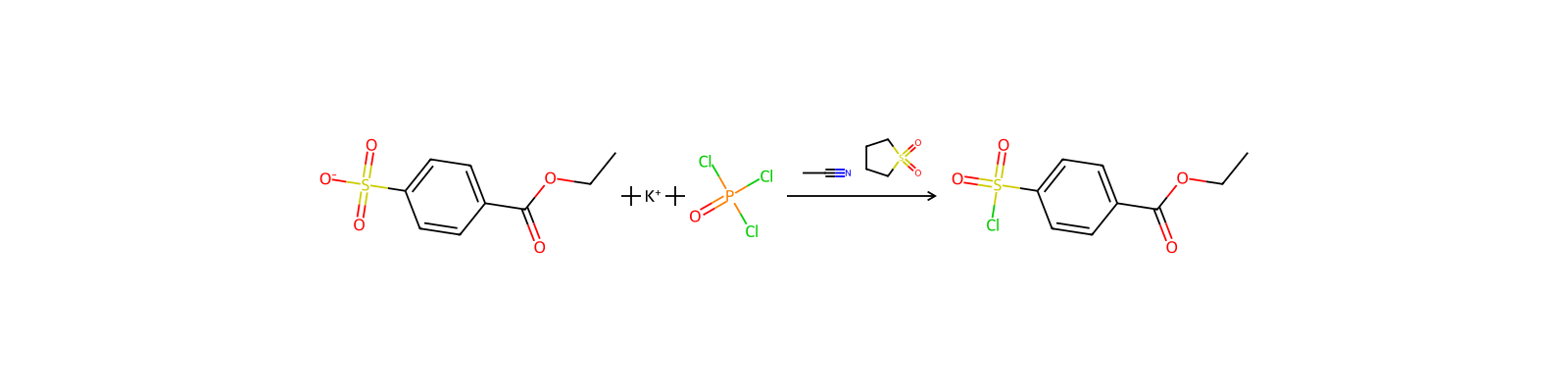
[CH2:1]([O:3][C:4]([C:6]1[CH:11]=[CH:10][C:9]([S:12]([O-:15])(=O)=[O:13])=[CH:8][CH:7]=1)=[O:5])[CH3:2].[K+].O=P(Cl)(Cl)[Cl:19]>C(#N)C.S1(CCCC1)(=O)=O>[CH2:1]([O:3][C:4]([C:6]1[CH:11]=[CH:10][C:9]([S:12]([Cl:19])(=[O:15])=[O:13])=[CH:8][CH:7]=1)=[O:5])[CH3:2]Participants
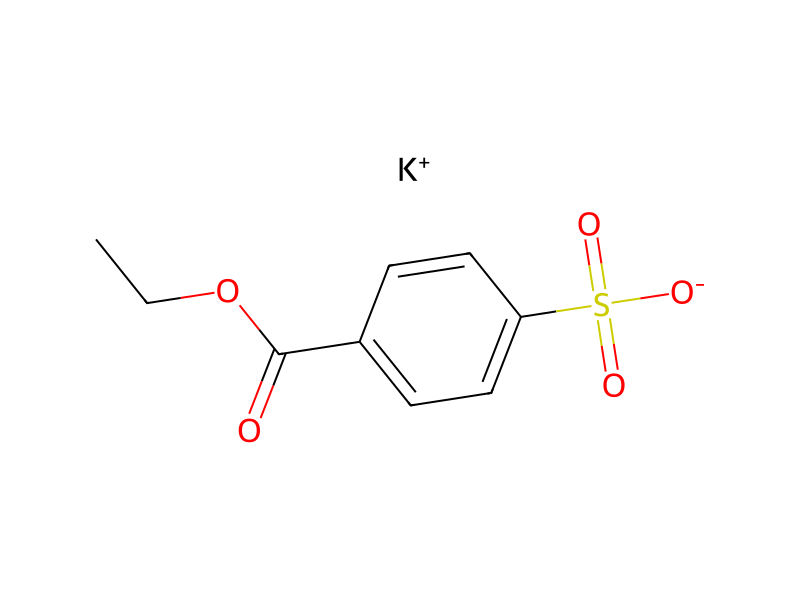
Reactant 2

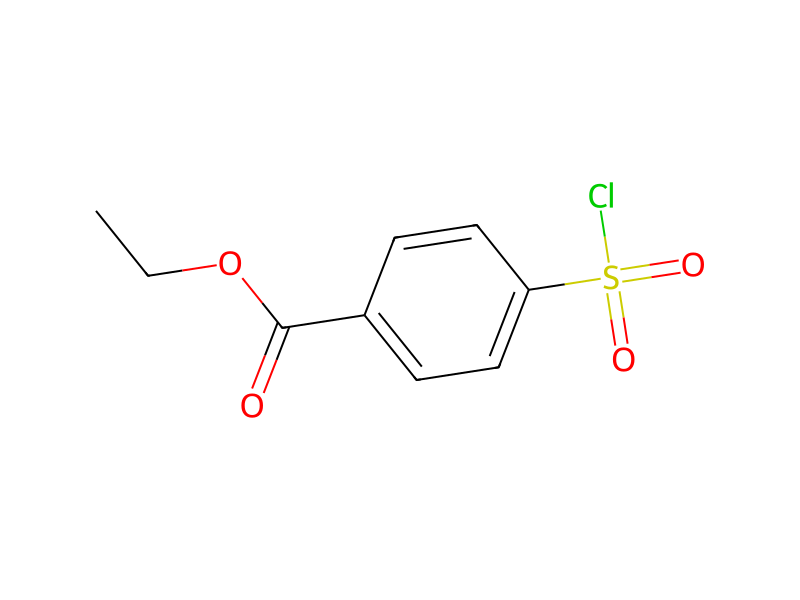
Product 1
Reagents, catalysts & solvents 2


Conditions
- Temperature
- 75 °C
Procedure
A round bottom flask, fitted with a magnetic stir bar and a hose adapter connected to a source of nitrogen gas, was charged with a solution of potassium 4-ethoxycarbonylbenzenesulfonate (75.1 g) dissolved in a 3:1 (v/v) mixture of acetonitrile (300 mL) and sulfolane (100 mL). As the solution was stirred, POCl3 (55 mL) was added slowly and the stirring mixture was heated at 75° C. under a nitrogen atmosphere for 3 hours. The heterogeneous reaction mixture was allowed to cool to room temperature and was then concentrated using a rotary evaporator. The flask was then cooled in an ice bath and ice was added to the mixture in the flask. The product crystallized as a white solid and was filtered and washed with cold deionized water. The product was dried under vacuum at room temperature and 3 mmHg for 2 hours to afford 76 g of white solid.
Workup
- customA round bottom flask, fitted with a magnetic stir bar and a hose adapter
- temperatureto cool to room temperature
- concentrationwas then concentrated
- customa rotary evaporator
- temperatureThe flask was then cooled in an ice bath
- additionice was added to the mixture in the flask
- customThe product crystallized as a white solid
- filtrationwas filtered
- washwashed
- customThe product was dried under vacuum at room temperature
Sources & evidence
- ORD record
- ord-ba1f189d3ecd43818b020a5a70fbedfa
- Source dataset
- uspto-grants-2010_06
- Patent number
- US07732633B2
Linked notes
Loading…