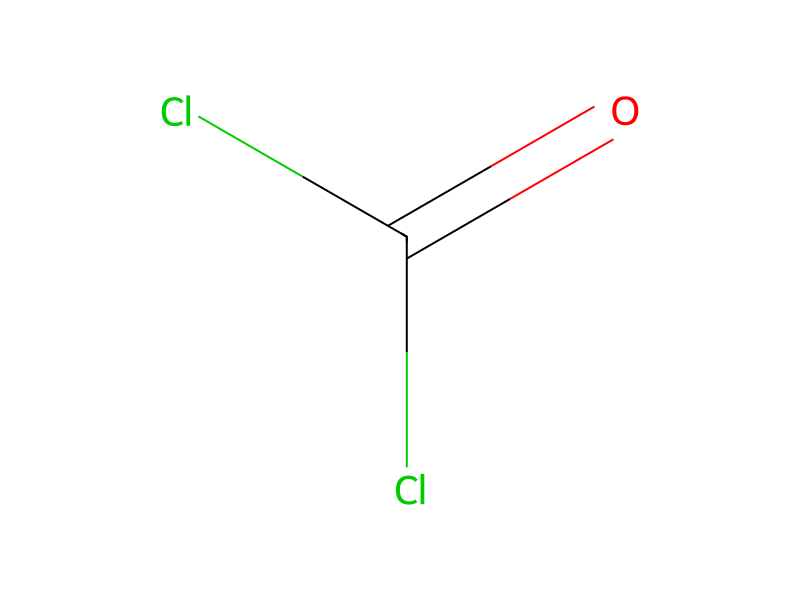
Ammonia → 2,3,5-Trichloropyridine
HRID 1577302
Reaction equation

[Cl:1][C:2]1[C:3](=O)[NH:4][CH:5]=[C:6]([Cl:8])[CH:7]=1.CN(C)C=O.C(Cl)([Cl:17])=O.N>C1(C)C=CC=CC=1.O>[Cl:17][C:3]1[C:2]([Cl:1])=[CH:7][C:6]([Cl:8])=[CH:5][N:4]=1Participants
7
[Cl:1][C:2]1[C:3](=O)[NH:4][CH:5]=[C:6]([Cl:8])[CH:7]=1.CN(C)C=O.C(Cl)([Cl:17])=O.N>C1(C)C=CC=CC=1.O>[Cl:17][C:3]1[C:2]([Cl:1])=[CH:7][C:6]([Cl:8])=[CH:5][N:4]=1
According to a preferred embodiment of the process of the invention, 3,5-dichloro-2-pyridone is suspended in toluene, the water present is separated by azeotropic distillation, 0.05-0.15 mol of N,N-dimethylformamide per mol of 3,5-dichloro-2-pyridone is added, and 1.0-1.3 mols of phosgene per mol of 3,5-dichloro-2-pyridone are introduced at 75°-80° C. After the addition of phosgene has been completed, the reaction mixture is allowed to react for a further one hour at 75°-80° C., and the excess phosgene is subsequently reacted with aqueous ammonia. The phases are afterwards separated, the solvent is distilled off from the organic phase, and 2,3,5-trichloropyridine is obtained as a melt.