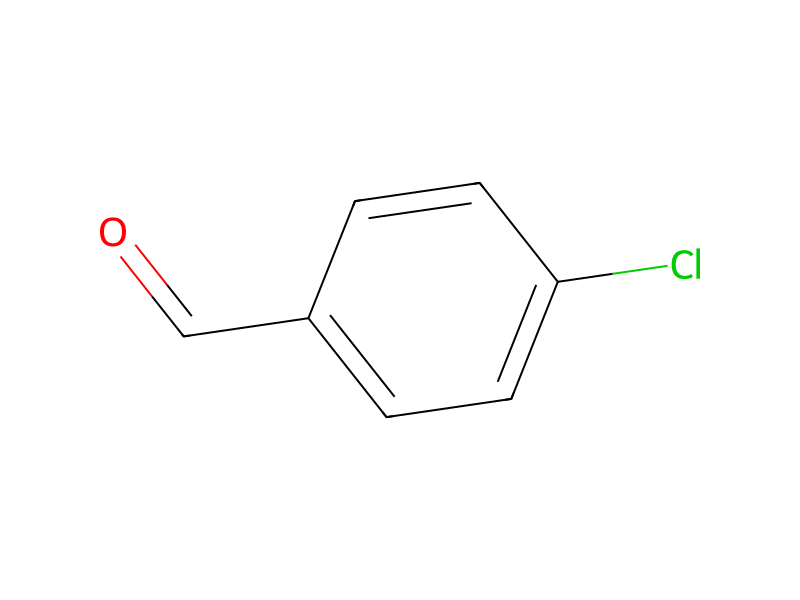
4-Chlorobenzaldehyde → HCID 20245839, compound
HRID 1589667
Reaction equation

[NH2:1][C:2]1[CH2:6][CH2:5][N:4]([C:7]2[CH:12]=[CH:11][C:10]([Cl:13])=[CH:9][CH:8]=2)[N:3]=1.[Cl:14][C:15]1[CH:22]=[CH:21][C:18]([CH:19]=O)=[CH:17][CH:16]=1>C(O)(=O)C>[Cl:14][C:15]1[CH:22]=[CH:21][C:18]([CH:19]=[N:1][C:2]2[CH2:6][CH2:5][N:4]([C:7]3[CH:12]=[CH:11][C:10]([Cl:13])=[CH:9][CH:8]=3)[N:3]=2)=[CH:17][CH:16]=1Participants
4
Reactant 2

Product 1

Reagents, catalysts & solvents 1

Procedure
3-Amino-1-(4-chlorophenyl)-2-pyrazoline (prepared in Reference Example 6 of our European patent specification No. 22-578) (1.95 g) in S.V.M. (5 ml) was mixed with excess 4-chlorobenzaldehyde (1.50 g) and the mixture was heated to reflux after the addition of 1 drop of glacial acetic acid. A virtually clear solution formed which rapidly crystallised to form a bright orange product which was collected, washed with S.V.M. and dried in vacuo to produce 2.95 g 3-(4-chlorobenzylideneamino)-1-(4-chlorophenyl)-2-pyrazoline, m.p. 193°-195° (decomp).