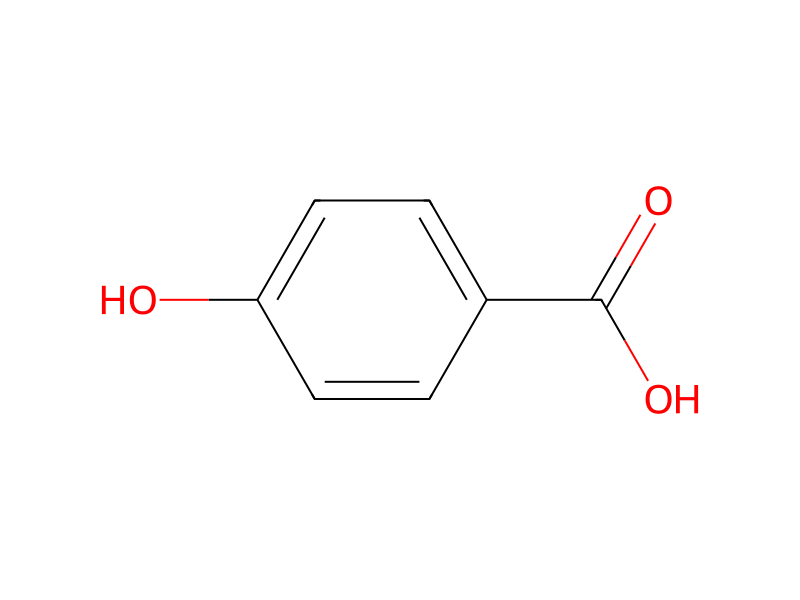
[OH:1][C:2]1[CH:10]=[CH:9][C:5]([C:6]([OH:8])=[O:7])=[CH:4][CH:3]=1.[CH2:11](Br)[CH2:12][CH2:13][CH2:14][CH2:15][CH2:16][CH2:17][CH2:18][CH3:19].[OH-].[K+].Cl>O.C(O)C>[CH2:11]([O:1][C:2]1[CH:10]=[CH:9][C:5]([C:6]([OH:8])=[O:7])=[CH:4][CH:3]=1)[CH2:12][CH2:13][CH2:14][CH2:15][CH2:16][CH2:17][CH2:18][CH3:19]12.7 Grams (0.0917 mol) of p-hydroxybenzoic acid, 28.5 g of n-nonyl bromide and 10.2 g of potassium hydroxide were added to a mixture composed of 1,500 ml (milliliter) of ethanol and 200 ml of water, and the mixture was allowed to react under reflux for 10 hours. Further, 500 ml of water was added thereto, and the mixture was stirred for 3 hours. After the completion of the reaction, a concentrated hydrochloric acid was added to acidify the reaction mixture. Thereafter, the solvent was distilled off, and the remaining product was cooled to room temperature and then filtered to give a colorless solid. The solid was fully washed with water and re-crystallized from chloroform to give an intended product (yield 75%).