Phenylhydrazine → HCID 59370088, compound
Reaction equation

CN(C)[CH:3]=[CH:4][C:5]([C:7]1[C:12](=[O:13])[CH:11]=[CH:10][N:9]([C:14]2[CH:19]=[CH:18][C:17]([C:20]([F:23])([F:22])[F:21])=[CH:16][CH:15]=2)[N:8]=1)=O.[C:25]1([NH:31][NH2:32])[CH:30]=[CH:29][CH:28]=[CH:27][CH:26]=1>CO>[C:25]1([N:31]2[C:5]([C:7]3[C:12](=[O:13])[CH:11]=[CH:10][N:9]([C:14]4[CH:19]=[CH:18][C:17]([C:20]([F:22])([F:21])[F:23])=[CH:16][CH:15]=4)[N:8]=3)=[CH:4][CH:3]=[N:32]2)[CH:30]=[CH:29][CH:28]=[CH:27][CH:26]=1Participants
4
Reactant 2
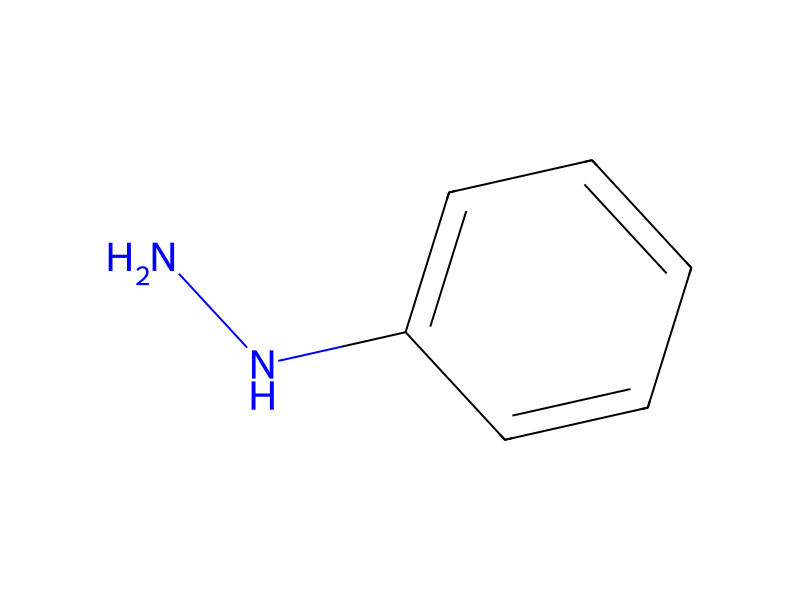

Product 1

Reagents, catalysts & solvents 1

Procedure
To a solution of 3-[3-(dimethylamino)prop-2-enoyl]-1-[4-(trifluoromethyl)phenyl]pyridazin-4(1H)-one (crude 718 mg, 2.13 mmol) in 20 mL of methanol was added phenylhydrazine (345 mg, 3.20 mmol). The mixture was refluxed for 4 h and concentrated. The residue was dissolved in dichloromethane (20 mL), washed with 1N HCl aqueous solution and brine, dried over Na2SO4, and concentrated under reduced pressure. The residue was purified by prep-HPLC to give 3-(1-phenyl-1H-pyrazol-5-yl)-1-[4-(trifluoromethyl)phenyl]pyridazin-4(1H)-one (100 mg, 12% for two steps) as a yellow solid.