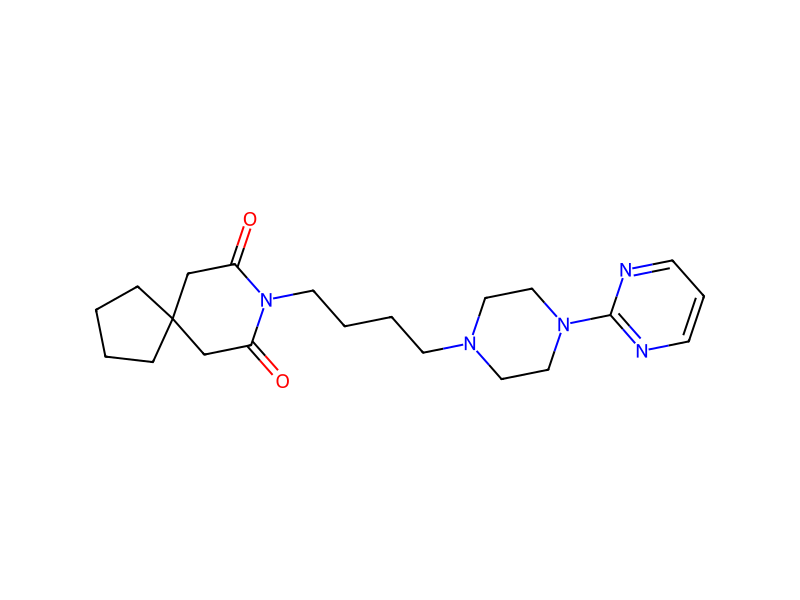
[CH2:1]1[CH2:5][C:4]2([CH2:12][C:10](=[O:11])[NH:9][C:7](=[O:8])[CH2:6]2)[CH2:3][CH2:2]1.[Br-].[N:14]1[CH:19]=[CH:18][CH:17]=[N:16][C:15]=1[N:20]1[CH2:29][CH2:28][N+:23]2([CH2:27][CH2:26][CH2:25][CH2:24]2)[CH2:22][CH2:21]1.C(=O)([O-])[O-].[K+].[K+]>C(O)CCC>[N:14]1[CH:19]=[CH:18][CH:17]=[N:16][C:15]=1[N:20]1[CH2:29][CH2:28][N:23]([CH2:24][CH2:25][CH2:26][CH2:27][N:9]2[C:7](=[O:8])[CH2:6][C:4]3([CH2:5][CH2:1][CH2:2][CH2:3]3)[CH2:12][C:10]2=[O:11])[CH2:22][CH2:21]1A mixture of 3,3-tetramethyleneglutarimide (7.5 g., 0.045 mole), 8-(2-pyrimidinyl)-8-aza-5-azoniaspiro[4.5]decane bromide (15.4 g., 0.045 mole), potassium carbonate (6.2 g., 0.045 mole) in 250 ml. of n-butanol is refluxed for a 21 hour period, filtered and evaporated to dryness. Residual material is warmed 45 minutes with acetic anhydride and evaporated to dryness. Water is added to the residue and the mixture basified with aqueous sodium hydroxide. Insolubles are collected and washed with water to provide 11.5 g. (66.5% yield) of 8-[4-[4-(2-pyrimidinyl)-1-piperazinyl]-butyl]-8-azaspiro[4.5]decane-7,9-dione as the free base, m.p. 90°-98° C.
Loading…