Reaction equation

S(Cl)(Cl)=O.[CH:5]([C:8]1[O:9][CH:10]=[C:11]([C:13]([OH:15])=O)[N:12]=1)([CH3:7])[CH3:6].[CH:16]1([NH2:19])[CH2:18][CH2:17]1.O>C1(C)C=CC=CC=1.CN(C)C=O.ClCCl>[CH:16]1([NH:19][C:13]([C:11]2[N:12]=[C:8]([CH:5]([CH3:6])[CH3:7])[O:9][CH:10]=2)=[O:15])[CH2:18][CH2:17]1Participants
Reactant 4




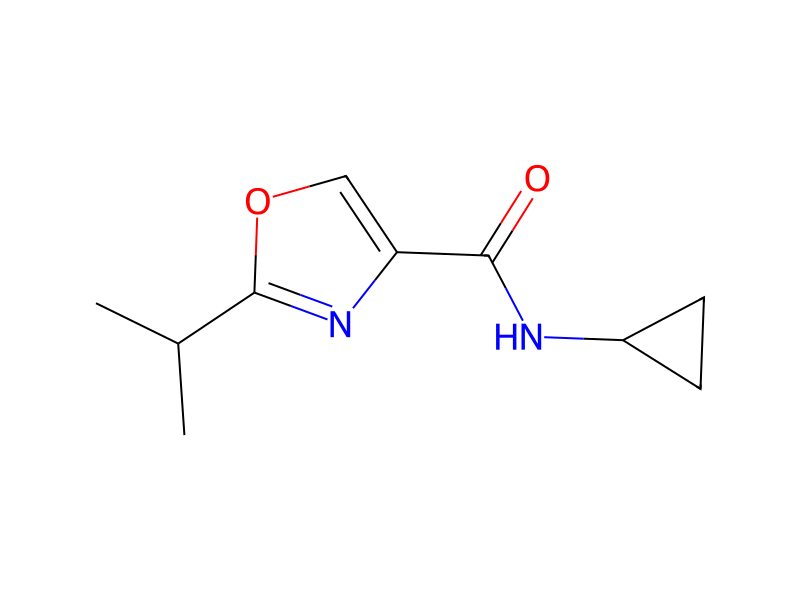
Product 1
Reagents, catalysts & solvents 3



Conditions
- Temperature
- 80 °C
Procedure
At room temperature, 47.6 g (0.40 mol) of thionyl chloride was dripped into a solution of 31.0 g (0.20 mol) of 2-isopropyloxazole-4-carboxylic acid in 200 ml of toluene and 2 ml of dimethylformamide, and the mixture was stirred for one hour at 80° C. The solvents were stripped off under reduced pressure, the residue was dissolved in 300 ml of dichloromethane, and 24.0 g (0.42 mol) of cyclopropylamine in 20 ml of dichloromethane was dripped in at 0° to 10° C. The mixture was stirred for 12 hours at room temperature, 150 ml of water was added, the phases were separated, the organic phase was washed once with saturated sodium bicarbonate solution and dried over magnesium sulfate, and the solvent was removed under reduced pressure. There was obtained 37.2 g (96%) of 2-isopropyl-oxazole-4-carboxylic acid-cyclopropylamide.
Workup
- customAt room temperature
- customwas dripped in at 0° to 10° C
- stirringThe mixture was stirred for 12 hours at room temperature
- customthe phases were separated
- washthe organic phase was washed once with saturated sodium bicarbonate solution
- dry with materialdried over magnesium sulfate
- customthe solvent was removed under reduced pressure
Sources & evidence
- ORD record
- ord-78bcc3aa486740f7976951928f9b982d
- Source dataset
- uspto-grants-1993_10
- Patent number
- US05256633
Linked notes
Loading…